
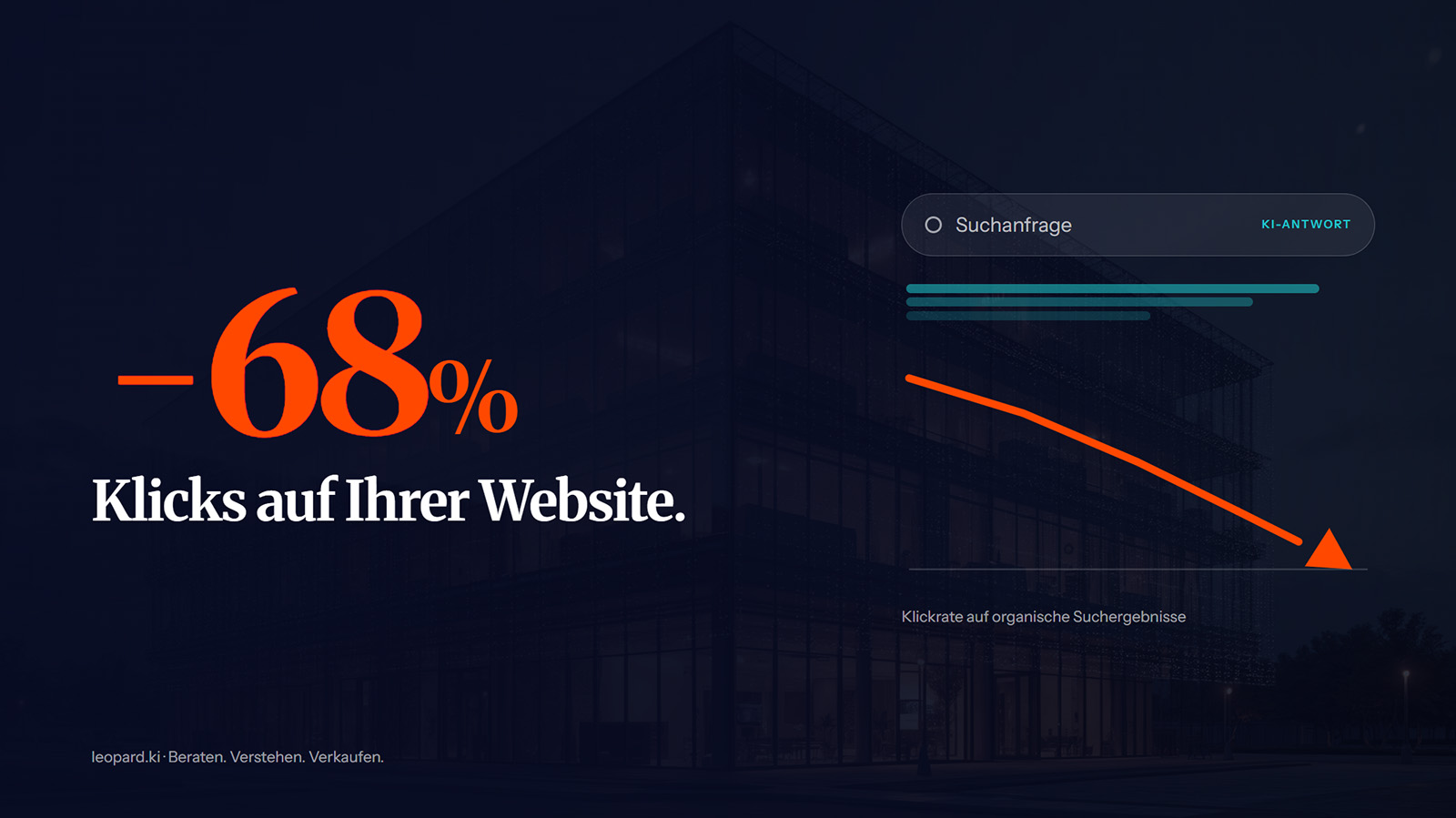

Almost anyone who works in marketing, sales, or runs a website has, at some point in the last two years, said or heard the sentence: "AI is changing search." By now it's close to a truism — people nod, they've read about it, some have started opening ChatGPT before Google. What gets lost in that nod is the pace and the size of the shift. Most people picture a gradual trend. The numbers describe something else: a break that, in a matter of a few years, has largely dismantled one of the most stable mechanics of the internet — the click from a search query to a website.
A few figures, each notable on its own, and hard to dismiss taken together:
According to SparkToro, roughly 68% of all Google searches in the US ended without a single click in early 2026 — the answer appears directly in the AI overview, and no site visit happens at all (Search Engine Land). For comparison: Similarweb measured a rise from 56% to 69% between May 2024 and May 2025 alone — this isn't a trend that's been quietly running for decades, it accelerated sharply in about two years.
At the level of individual result pages, it's even more pronounced. Ahrefs analyzed roughly 300,000 keywords in February 2026 and found that the click-through rate for position 1 fell from 7.3% to 1.6% once an AI overview appeared — a 58% decline after adjusting for general trends (eMarketer). The Pew Research Center reached a similar conclusion in an independent study of roughly 69,000 search queries (July 2025): only 8% of users still clicked a classic result when an AI overview was shown, versus 15% without one — and just 1% clicked through to any of the sources cited within the AI answer itself.
That last figure is the one that captures the scale best: even when a website is cited as a source, in the overwhelming majority of cases that no longer results in a visit. The website supplies the information. The AI delivers it.
There's a simple reason this shift hasn't landed with most companies at its actual scale: it doesn't show up as an event, it shows up as a slow decline in an analytics chart — easy to mistake for seasonality, an algorithm update, or just "a slower month." According to a McKinsey analysis cited by Writer.com, only 16% of brands currently track their visibility in AI answers in any systematic way (Writer.com). The other 84% see the traffic decline, but not the cause behind it.
There's a second, economically larger factor that barely comes up in the public conversation: Gartner projects that by 2028, AI agents will independently influence or execute $15 trillion worth of B2B purchasing decisions (Digital Commerce 360). That's not a footnote to the search story — it's a claim that it isn't just information-seeking that's moving to AI systems, but the early stages of B2B purchasing itself, increasingly happening between systems before a human ever opens a website.
There's one area where the pattern reverses: searches that already include the company name. Here, AI overviews show up to 18% higher click-through rates when the brand is named in the answer. Once you're cited as a source, or recognized as a brand, you don't lose in that moment — you gain. This exception is telling, because it shows the shift isn't purely a loss mechanism, it's a redistribution: visibility is moving from "ranking somewhere on page one" to "being the source the answer itself cites." Being cited once makes you more likely to be cited again — according to Writer.com, 85% of brand mentions in AI search results now come from third-party sites, not from a company's own website. Visibility is increasingly happening in places a company has little direct control over.
One caveat belongs here, for the sake of accuracy: the most solid figures on this trend come mostly from the US, and from large publishers with high volumes of generic, informational search traffic. For German B2B niche markets — mechanical engineering or measurement technology, for instance — the effect is plausible but hasn't been independently measured yet. Google also actively disputes that AI overviews are the cause of declining click numbers. Independent of that dispute, though, one thing is measurable without controversy: information-seeking is shifting to AI systems at a measurable pace. How fast and how hard that hits any specific niche is an open question — that the direction is the same is much less of one.
The obvious reaction is to treat this as an SEO problem — better keywords, more content, more backlinks. The numbers suggest something different: the priority is no longer primarily about being found, it's about whether your information is structured in a form AI systems can actually read and cite in the first place — and what happens on the rare occasion someone still clicks through. For anyone who wants to see what this means concretely for their own website and sales process, the SEO Engine page goes into more detail on how this shift plays out in everyday B2B terms.
Get in touch for access or support.
Request a personalized showcase of leo.live, or get your copy of Magazine 2026. Both are free, and neither commits you to anything.