

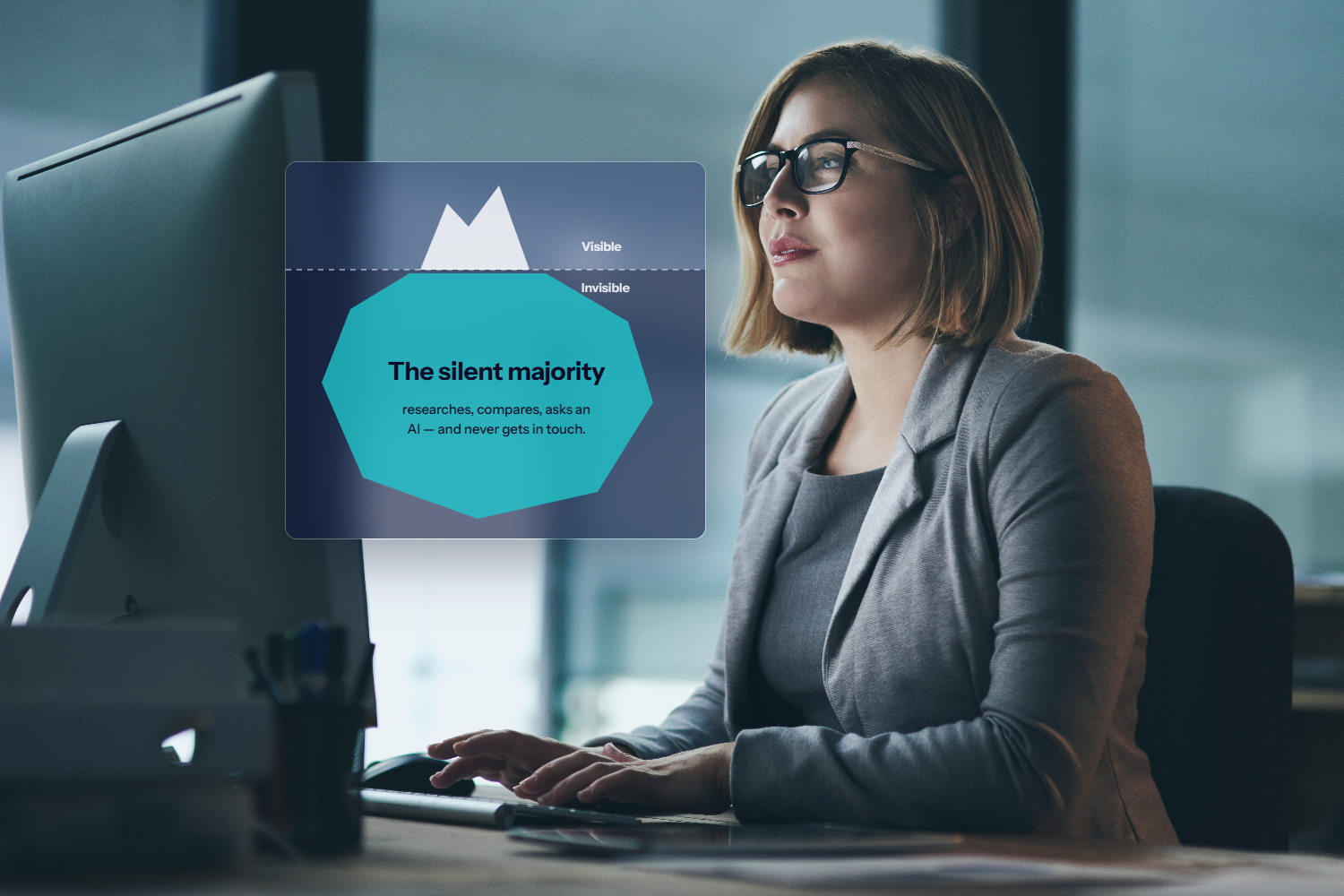

Every sales team knows its prospects: the calls, the emails, the conversations at the trade-show booth, the visitors in the showroom. This is where your team is strong. This is where it advises, asks the right questions and convinces.
But that is only the tip of the iceberg. Below the waterline sits a silent majority: people who are interested in your products, who research and compare – and who never get in touch. They never appear in your CRM, in your inquiry statistics or in a sales conversation.
Several studies on B2B buying show how large the invisible part is:
Consumer business looks similar. According to Deloitte, 52 percent of German consumers were already using AI shopping assistants in May 2026, mainly to compare prices and products. [5]
One caveat: these studies are based on surveys, and the B2B data comes largely from international samples. The direction is clear nonetheless.
The invisible part has faces. An engineer checks in the evening whether a measuring system meets his tolerance and finds no clear answer in the data sheet. A family is torn between two hot tub models and wants to know which one is quieter and what it costs to run in winter. A buyer compares three suppliers for a component before even drawing up a shortlist.
They all have a concrete question. And they ask it wherever they get an answer right away: in a search engine, in ChatGPT, on a competitor's website. Your team would answer the question in two minutes. But nobody calls at 10 p.m. – and hardly anyone fills out a contact form for a quick follow-up question.
If you only see the tip, you draw the wrong conclusions. The inquiries that do arrive often come from buyers who made up their minds long ago. Those who drop out leave no trace: no lost quote, no rejection, just an anonymous session in your web analytics. Your website statistics show which pages were visited – but not which question remained unanswered.
That leaves sales without the very knowledge it needs most: What really concerns prospects before they get in touch? And where does your own website lose them?
You cannot argue the iceberg away. But you can make more of it visible. That takes three things:
This is exactly what leo.page does. An input field on your existing homepage takes the question. The AI advisor answers based on your product and company knowledge, asks follow-up questions and guides visitors to the right product or the right contact person. With leo.live you can see which questions are being asked – by topic, purchase intent and urgency. The silent majority becomes part of your sales process.
Your team is strong wherever it meets prospects. The problem is that it never meets most of them. Answering the silent majority's questions on your own website wins you more than additional inquiries – it gives you insight into a market that has been invisible until now.
What would an AI advisor look like on your homepage? Request a free preview with your own products – delivered by email within three working days.
Request your free website preview →
As of 4 November 2026. The figures are based on surveys; the B2B studies refer largely to international samples.
[1] 6sense: 2025 B2B Buyer Experience Report. Survey of nearly 4,000 B2B buyers. 6sense.com
[2] Gartner: Gartner Sales Survey Finds 67% of B2B Buyers Prefer a Rep-Free Experience. 09.03.2026; survey of 646 B2B buyers, August–September 2025. gartner.com
[3] Demand Gen Report: Gartner: 67% of B2B Buyers Prefer a Rep-Free Experience. 17.03.2026. demandgenreport.com
[4] destinationCRM: Buyer Enablement Is the Key to B2B Sales (on Gartner research into the B2B buying journey). destinationcrm.com
[5] Deloitte: The State of Agentic Commerce in Europe – press release. Online survey of 13,500 consumers in 15 countries, including 1,500 in Germany, May 2026. deloitte.com
Get in touch for a preview, a demo or support.
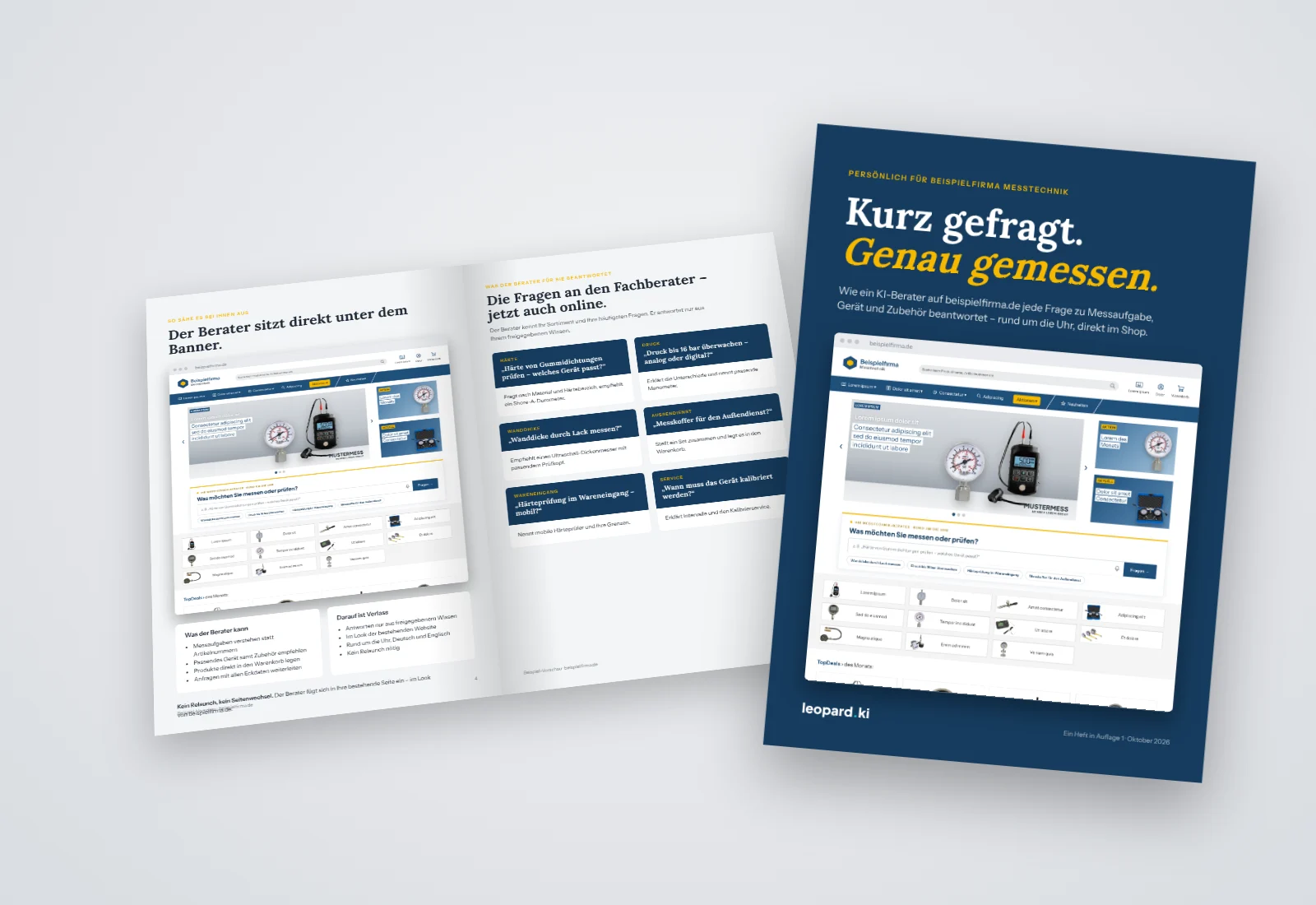
Get a free preview of your own homepage with the advisor field, by email within 3 working days. Or book a demo with a selection of your own products. Both are free and non-binding.
Replies within one business day.