


The new version is live now and can be tried directly at leo.ki. Our own showcase doesn't just explain how leo.page works: it is itself a leo.page.
Visitors can orient themselves as they would on a normal website, discover content, and explore topics. At the same time, they can ask their own question at any moment and start a personal consultation with the AI. This turns the website from a purely informational offering into a decision-making interface.
A central innovation in leo.page 5.0 is the follow-up cluster.
Many people don't yet know exactly what question to ask at the start of their research. That's why leo.page no longer just waits for free-text input. The AI can proactively enter the dialogue, ask targeted follow-up questions, and offer relevant options to choose from.
It might ask, for example: "What industry do you work in?" — and immediately show several relevant industries to choose from. The next step emerges from the answer. The follow-up cluster develops dynamically from the conversation so far, guiding the user step by step toward their specific use case.
This creates a smoother dialogue flow: the visitor doesn't need to have fully formulated their request from the start. leo.page helps them clarify their needs, narrow down options, and identify the right solution.
This is more than a predefined click-path. The options become part of a genuine dialogue and can change depending on previous answers.
leo.page 5.0 is also a major step forward in design.
The new layout is barely distinguishable from a classic, professionally designed website. Text, images, navigation elements, topic areas, and dialogue merge into a single, unified interface. The AI is no longer a separate chat window sitting on the edge of an existing website — it becomes a central part of the entire user journey.
For companies, this means: they no longer have to choose between an appealingly designed website and an intelligent consultation solution. leo.page combines both in one system.
Based on our market observation, this combination of a full-fledged website, dynamic dialogue, and downstream demand analysis remains unique.
Language models fundamentally generate answers based on statistical probability. That works surprisingly well for general explanations. But for technical products, prices, compatibilities, variants, or binding quote data, "probably correct" isn't good enough.
That's why leo.page 5.0 can be connected to a structured product database. Binding product information is then no longer estimated by the language model, but taken directly from the stored data and rules.
For clearly defined product data, this means: the answer is only as precise as the underlying database. If the data is complete and up to date, leo.page can use exactly the values, combinations, and dependencies stored there.
This enables a level of precision that an ordinary chatbot without a structured data foundation cannot achieve. This is especially important for complex B2B products, where a single incorrect technical specification, an unsuitable combination, or an overlooked dependency can lead to an unsuitable quote.
On this basis, quotes can also be generated automatically — not as a free estimate by the language model, but based on the stored product data, configuration rules, and information gathered from the customer dialogue.
leo.page 5.0 also adds optional agentic capabilities. This means the AI can not only inform, but also — within clearly defined processes and approvals — take on tasks.
One example is automatically answering incoming emails based on the stored company and product knowledge. Other workflows can be connected as well: from preparing a quote, to structured handoff to sales, to triggering downstream processes.
Which functions are used is up to the company. leo.page can start as a pure consultation solution and be extended step by step with agentic capabilities as needed.
The core principle remains unchanged — but is implemented more consistently with version 5.0:
In the analytics section of leo.live, these dialogues are then evaluated. This turns digital consultation into a direct window onto real market demand.
Our new website doesn't just explain leo.page — it shows the product in action.
Ask Leo at leo.ki whatever question is currently on your mind about sales, marketing, or your website. Or let the follow-up clusters guide you to your own use case.
leo.page 5.0 is live. Advise. Understand. Sell.
Get in touch for a preview, a demo or support.
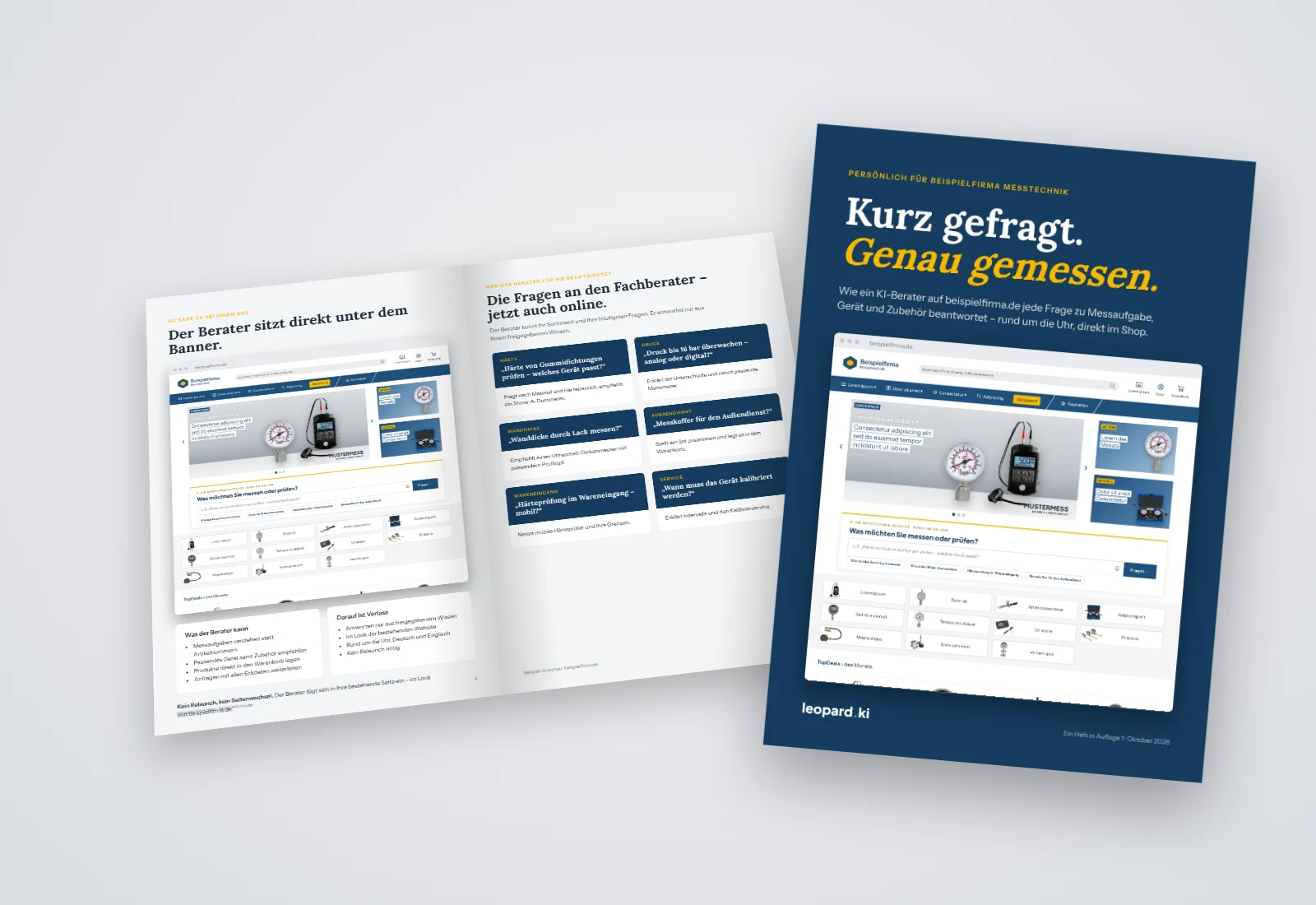
Get a free preview of your own homepage with the advisor field, by email within 3 working days. Or book a demo with a selection of your own products. Both are free and non-binding.