
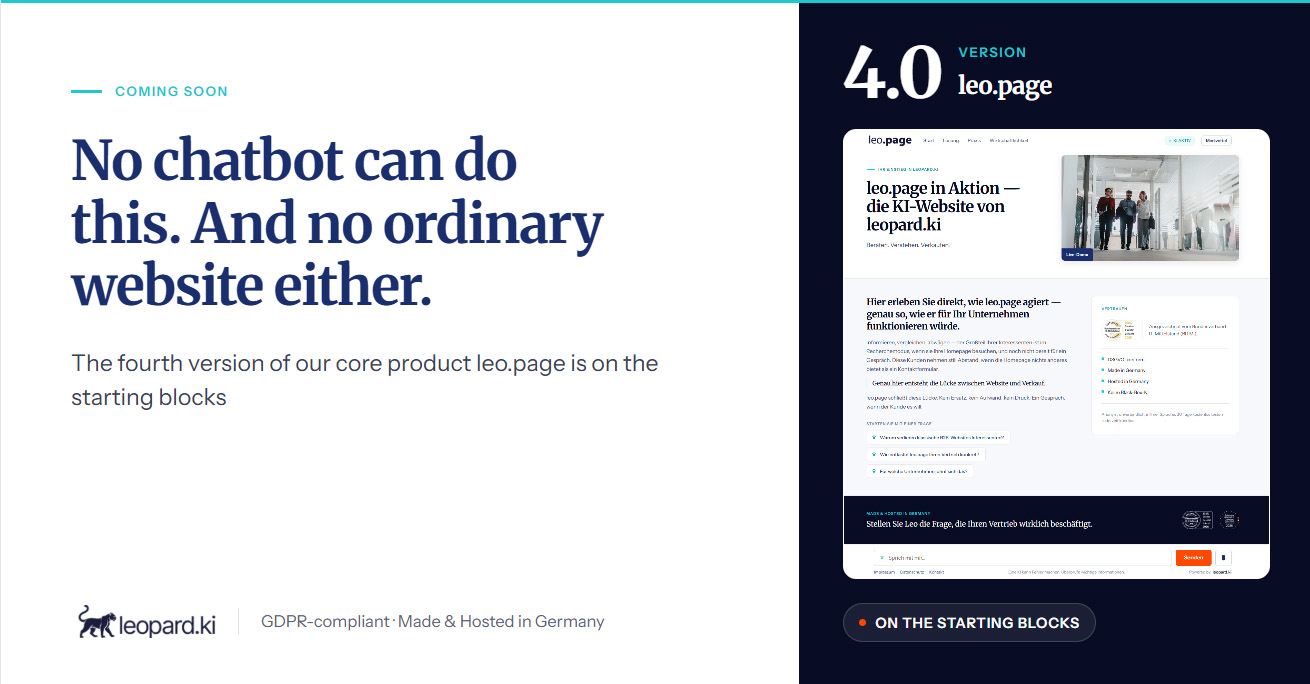

In a few days, the fourth version of leo.page goes live. The version number is almost beside the point — this is the first release that actually delivers what we set out to build from the start: a website that looks and feels like any other homepage, but behaves exactly the way visitors and customers have come to expect from AI — attentive, useful, and oriented toward actually solving their problem, not just displaying information.
On the surface, leo.page v4 is indistinguishable from a well-built company website. That's deliberate. Underneath, it behaves completely differently. It isn't an information page that waits for a visitor to click through subpages and eventually find a contact form. It's a communication tool that engages directly with the visitor, responds to what they actually came to ask, and answers exclusively from the company's own curated knowledge base — never from a generic model improvising on the open internet. In practice, that makes it closer to a spokesperson for the company than a static page: it doesn't just inform visitors, it actively turns them into customers.
No chatbot achieves that. Neither does a conventional website. Both hand the visitor either a script or a wall of text and leave the rest to them.
The technology behind that kind of dialogue is only half the story. The other half is whether people are actually willing to have the conversation in the first place. According to Pew Research, about 49% of europeans have now used an AI chatbot — up sharply from 33% just two years earlier. That's real, fast-moving adoption. It also means roughly half of the people who land on a company website still haven't, and for a meaningful share of them, talking to an AI system isn't yet something that feels natural.
That's exactly the group leo.page v4 was designed not to lose. The new version adds several human-in-the-loop functions that make the dialogue with the AI advisor noticeably more playful and easier to start — small design and interaction choices that lower the barrier before the first question is even typed. The goal isn't to convince someone that AI is trustworthy in the abstract. It's to make the first thirty seconds of a conversation feel comfortable enough that hesitation doesn't get the last word.
There's a more personal layer to this release. leo.page v4 is the version where an idea we've been chasing since the company's earliest days finally holds together: an AI-driven website that customers don't have to brace themselves for. We've watched enough of the reluctant half quietly leave a company website the moment a chat window pops up, uninvited, in the corner. Building something that same group would actually want to use — rather than route around — has been the real target the whole time. This is the first version where we think we've hit it.
leo.page v4 launches in the coming days. If your website today is either a static brochure or a chatbot bolted on top of one, that's precisely the gap this version is built to close — for the visitors who already talk to AI every day, and for the ones who still hesitate at the door. See what leo.page does, or read what leo.live shows once those conversations start happening on your own site.
Get in touch for access or support.
Request a personalized showcase of leo.live, or get your copy of Magazine 2026. Both are free, and neither commits you to anything.