
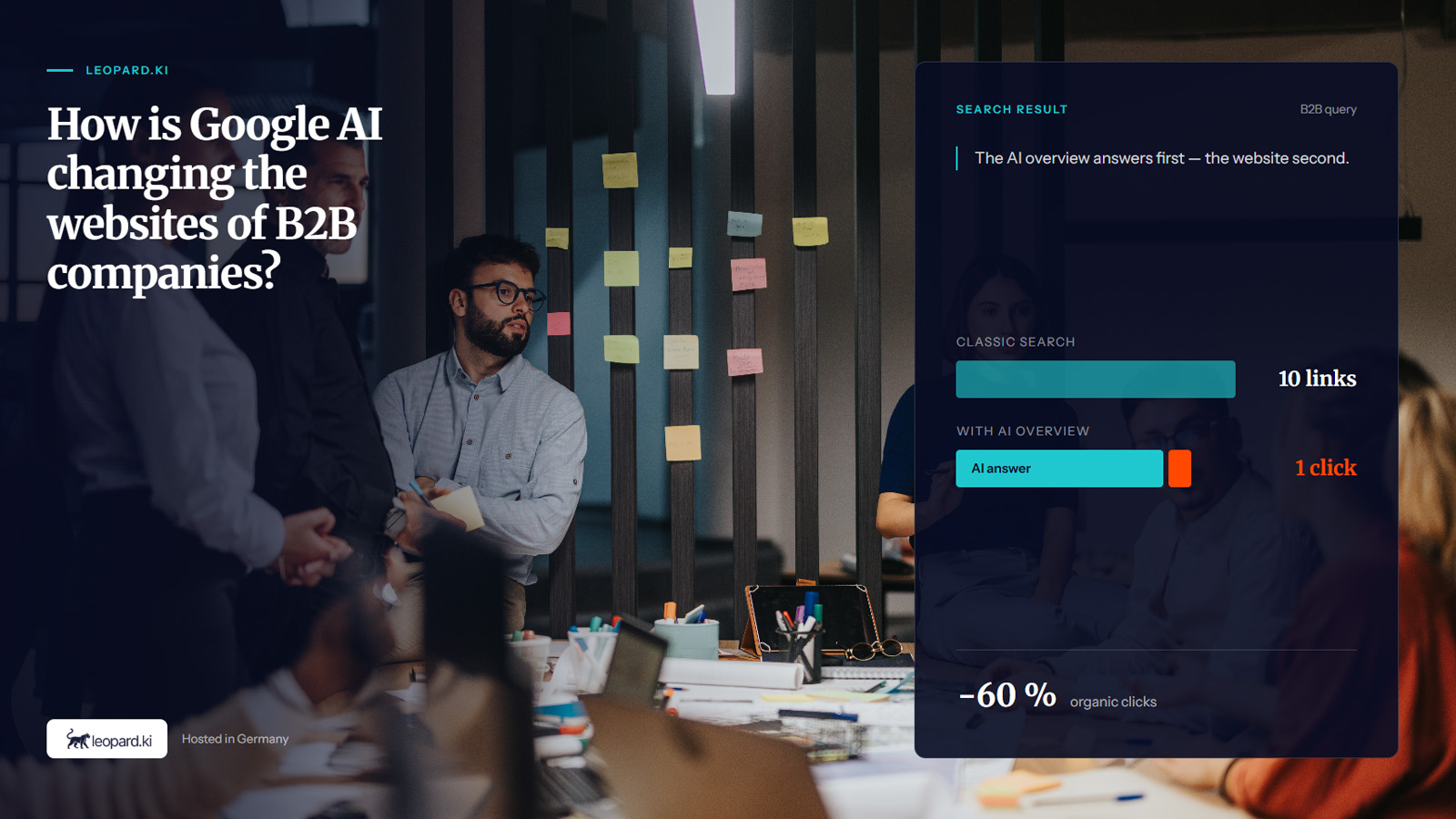

The short version: Google now answers a growing share of general information questions directly in search results, so for those questions a buyer no longer needs to visit a manufacturer's website at all. What doesn't disappear are the questions Google can't answer — whether a specific product fits a specific machine, application, or tolerance. That shifts what a technical B2B website is actually for: less about presenting information, more about interpreting it and supporting a decision in a specific case. How much traffic this actually costs is genuinely disputed between Google and independent researchers. That the job of a website visit is changing is much less disputed.
Two things, now converging. AI Overviews are the AI-generated answer that appears above the classic list of results — a user gets it without asking for it. AI Mode is the conversational version: longer questions, follow-ups, comparisons, several search steps inside one exchange. Neither is a preview any more. AI Mode rolled out to more than 40 additional countries on 8 October 2025, and at Google I/O 2026 Google explicitly merged the two, bringing "AI Overviews and AI Mode into one, seamless AI Search experience" — question, then a results page with an AI answer, then a follow-up in AI Mode, all in one flow.
On scale: Google reports more than 2.5 billion monthly users for AI Overviews, and in its July 2026 quarterly remarks, more than one billion monthly active users for AI Mode. This isn't an experiment running in a corner of the product any more. It's the default surface.
For a managing director, the product distinctions matter less than the direction of travel: Google is moving from returning a list of links toward being a system that answers the question itself, explains context, and handles what you ask next.
On searches where an AI answer appears: yes, measurably. Ahrefs re-ran its study using December 2025 data and found roughly a 58% lower click-through rate for the position-one result when an AI Overview is present. What that figure does not say matters just as much: it measures CTR at position one on informational queries that trigger an AI Overview — not total traffic to a website. The dataset is 300,000 keywords (150,000 with AI Overviews, 150,000 informational without), predominantly English-language, and Ahrefs itself frames the result as correlation: the drop may also reflect other search-result features and the broader zero-click trend.
For non-English markets there's now separate evidence. SISTRIX analysed over 100 million German keywords and found position-one CTR falling from 27% to 11% when an AI answer appears — close to 60%, and strikingly consistent with the English-language finding. Around 20% of German keywords now show an AI answer, which extrapolates to roughly 265 million lost organic clicks per month across the German market, averaging 6.6% of all organic clicks. The spread across industries is wide, from under 1% to more than 24%.
The widely quoted zero-click number needs careful handling. SparkToro found that from January to April 2026, about 68% of Google searches in the US ended without a click. That's a US figure, based on Similarweb clickstream data, and it is explicitly not attributable to AI answers alone — knowledge panels, featured snippets, maps and direct answers long predate them. SparkToro notes that in the same period only 0.34% of searches happened in AI Mode at all. Zero-click is an old trend that AI answers are accelerating, not one they invented.
Because Google is measuring a different layer. In an official post, Liz Reid, Head of Google Search, writes: "Overall, total organic click volume from Google Search to websites has been relatively stable year-over-year." Google adds that average click quality has risen — meaning clicks where users don't immediately bounce back — and that with AI Overviews "people are searching more and asking new questions that are often longer and more complex." In its July 2026 quarterly remarks, Google says it is still sending "billions of clicks to websites every week" through AI features.
These claims conflict less with the studies than they first appear, because they measure different things. Ahrefs and SISTRIX measure click-through rate at a specific position on a specific type of query. SparkToro measures user behaviour across a whole session. Google talks about aggregate click volume across all searches, plus a quality metric it defines itself. All three can be true at once: informational queries lose clicks sharply, while total query volume grows, making the aggregate look steadier than any individual result. It's more honest to leave that tension standing than to declare a winner — particularly since Google hasn't published the underlying quality data.
For any individual manufacturer, the practical conclusion is simple: none of these numbers tell you what's happening to your traffic. Only your own Search Console does, broken down by which kinds of queries are affected.
This is where it gets concrete for technical manufacturers. "What is a pressure transmitter?", "How does a flow meter work?", "What does plate mounting mean in flexographic printing?" — these are general information questions. They can be summarised from publicly available knowledge, which is exactly what an AI answer does well. If a product page's main job is explaining a technical term, it is now competing, on that question, with an answer already sitting at the top of the page.
These questions are a different matter:
Answering these requires knowledge only the manufacturer holds: design limits, field experience, compatibility, the failure modes that show up in practice. An AI system can only address them if that knowledge exists publicly and is clearly attributable — and even then, the buyer's own specific case is still open.
From that follows a strategic conclusion, and it is explicitly a conclusion rather than a measured causal relationship: the better general information questions are answered before the visit happens, the more the remaining value of a manufacturer's website shifts toward application, selection, and decision questions.
No, and this claim deserves scepticism. Google's "quality clicks" is Google's own definition, not an independently verified measure. There is research showing higher conversion from AI-referred visitors: an Orbit Media analysis of 97 B2B websites and roughly 29 million sessions (July 2025 to June 2026) found a 1.91% conversion rate for AI-sourced visitors versus 0.71% from organic search. But that study explicitly does not measure Google AI: traffic from AI Overviews and AI Mode is recorded in analytics as ordinary organic search, so what was actually measured is chatbot referrals — which accounted for just 0.5% of all traffic.
The defensible version is narrower: if simple information questions are handled in search, the remaining website visits can weight more heavily toward deeper information, specific applications, and decisions. That is a different claim from saying every remaining visitor is a qualified buyer.
Four things follow from the above.
Less interchangeable self-description. "Innovative solutions since 1972" answers no question — not a person's and not a search system's. Specific statements about products, applications, problems solved, technical limits, and who it's for do.
More answers to real decision questions. Which product when? A or B? What size, what accuracy, what compatibility, what constraint? These are the questions that come up in every sales conversation anyway. They belong on the website, before anyone picks up the phone.
Decision content rather than catalogue content. Comparisons, selection guidance, documented applications, configuration logic, real customer questions. That's what separates a website that displays from one that helps someone judge.
Original expertise. Google's current guidance for site owners emphasises valuable, non-interchangeable content with a genuine perspective. Manufacturers have a structural advantage here over generic advice sites: they hold knowledge from engineering, application, and service that nobody else has. It just usually isn't public.
Yes — and it doesn't require a new secret technique. In its "AI features and your website" documentation, Google states plainly that there are no additional technical requirements for AI Overviews or AI Mode: "There are no additional technical requirements," and the same foundational practices as for regular Google Search continue to apply. Anyone currently being sold special file formats or markup tricks specifically for AI answers should weigh that claim against Google's own statement.
A separate question does arise alongside it: will your company even be considered and cited in AI-generated answers in the first place? That has its own logic and is covered in a separate article.
A review you can run yourself in half an hour. Does your website clearly answer:
Then the real question: if a prospect described their specific situation, could your website help them make a decision? For most technical B2B sites, the honest answer is that it could help them find information. On the decision itself, they're on their own.
That's the gap leo.page is built for. Instead of leaving a visitor alone with navigation, product lists, and datasheets, it lets them describe their actual case in their own words: leo.page understands the question, asks follow-ups where needed, draws on the company's curated product and application knowledge, separates the solutions that fit from the ones that don't, and guides them to a sensible next step. Those conversations then feed leo.live, which surfaces which questions are really being asked, which applications matter, and where the information gaps are — the raw material for exactly the kind of content a website needs in this new role.
What Google is changing, then, is less about whether people find websites. It's changing what they still need a company website for. The more general information is available before the click, the more it matters what happens when someone arrives with a specific case. For a fuller look at how this shift plays out in everyday B2B terms, the SEO Engine page goes into more detail.
Get in touch for access or support.
Request a personalized showcase of leo.live, or get your copy of Magazine 2026. Both are free, and neither commits you to anything.