
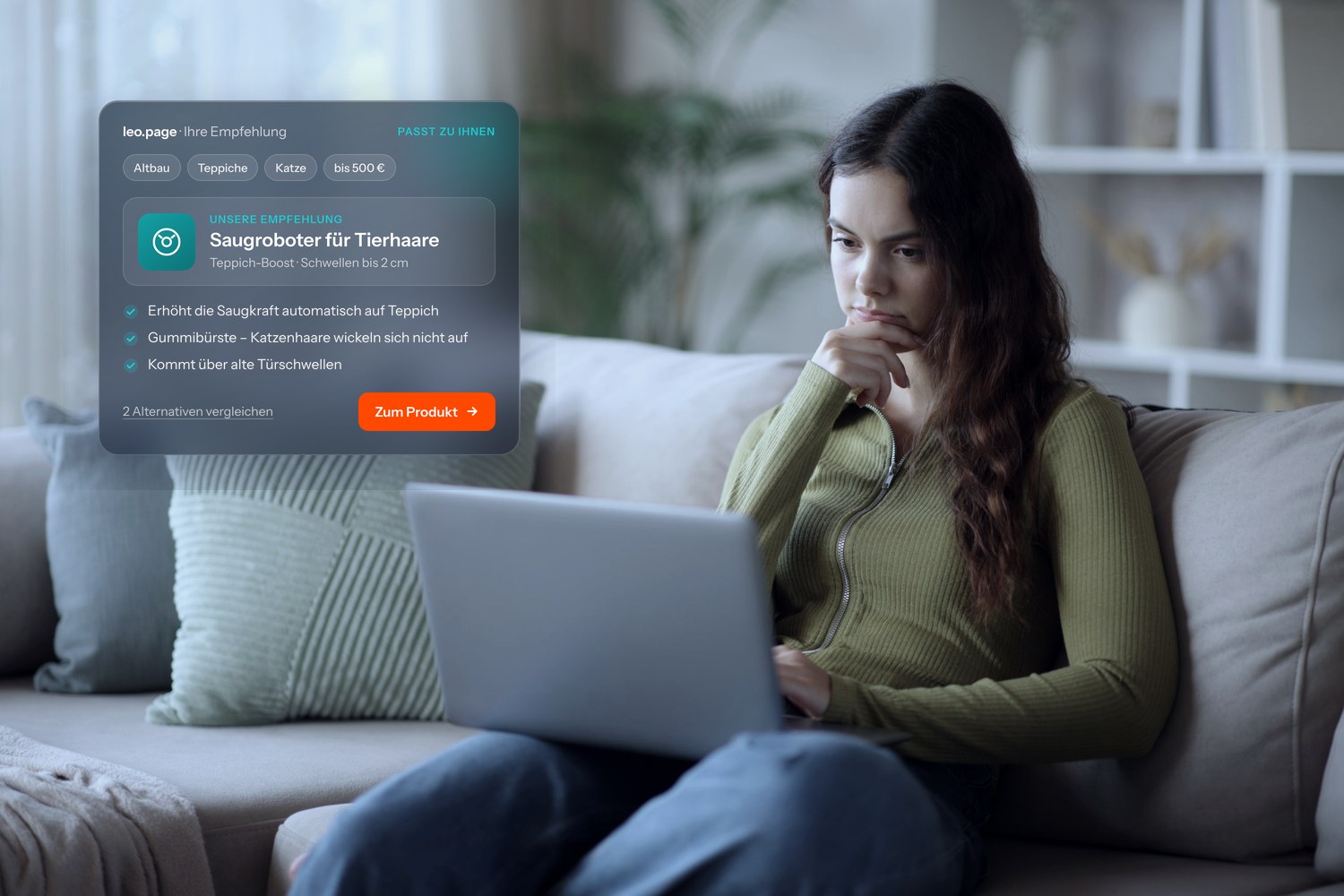

Running shoes for a first half marathon. A robot vacuum for an old apartment with rugs and a cat. A measuring device for a specific tolerance. More and more people no longer start purchases like these with a search term, but with a question to an AI. ChatGPT, Google and Amazon have responded. The obvious conclusion: every online shop now needs its own AI advisor.
It isn't quite that simple. This year's studies paint a more nuanced picture – and point to a development that is more opportunity than threat for retailers: customers let AI advise them, but most still buy from retailers they know.
ChatGPT was given a new shopping experience in March 2026: visual product overviews, side-by-side comparisons and refinement through conversation. At the same time, OpenAI scaled back direct purchasing inside the chat. Merchants now handle checkout through their own systems again. [1]
Google offers its AI Mode in Germany too. It answers complex questions in natural language and lets people follow up – a search that feels like a conversation. [2]
Amazon reports more than 300 million users of its AI shopping assistant Rufus in 2025, now renamed Alexa for Shopping. According to Amazon, customers who use it during a shopping trip are more than 60 percent more likely to complete a purchase. [3] [4]
One detail is easy to miss: OpenAI itself returned checkout to merchants. Advice can happen anywhere. The purchase still needs a store people trust.
AI has become part of everyday shopping in Germany. According to a Deloitte study, 52 percent of German consumers used AI shopping aids in May 2026 – up from 44 percent in September 2025. They use them mainly to compare prices and products. Yet only around 6 percent would hand the purchase decision over to AI entirely. [5] [6]
US data shows how traffic is shifting. Adobe Analytics measured 62 percent more visits to US retail sites from AI sources in July 2026 than a year earlier. These visitors converted at a 60 percent higher rate and generated 53 percent more revenue per visit than other traffic. [7]
Where people end up buying is just as revealing:
A caveat: much of this comes from the US, is self-reported or was published by technology vendors. The direction is still clear. Research is moving to AI. The purchase stays with the retailer.
Anyone who has asked ChatGPT for a robot vacuum for an old apartment with rugs and a cat expects the same in the shop. Instead, they often find filters for suction power in pascals, battery capacity and brush type. The customer knows their situation – not which technical value fits it.
German consumers say so directly: in a representative Algolia survey from June 2026, better product search tops the list of improvements they want from online shopping. [10]
Retailers' own AI offerings face high expectations as a result. In a Nosto-commissioned survey, 69 percent of consumers who had received irrelevant suggestions from an AI shopping assistant gave up on it and searched elsewhere. At the same time, 48 percent said they would be open to an AI assistant from their favorite retailer. [11]
When product recommendations increasingly come from AI, the shop risks being reduced to the checkout. That leads to two tasks.
First: stay visible to AI. Assistants can only recommend products they understand. That requires complete, structured product information – properties, areas of use, limits, compatibility.
Second: continue the conversation. A visitor who arrives from ChatGPT usually has a shortlist and new questions: Does this model really fit my apartment? What is the difference from the cheaper variant? If the shop then drops them back into a filter list, they return to the AI – or go to Amazon.
There is a third point that is often overlooked: what customers ask ChatGPT, the retailer never sees. On your own website, the same questions become a valuable source – about what customers need, what is unclear, and where information is missing.
An integrated AI product advisor brings the familiar pattern of ChatGPT to your own website – with your own range as its basis:
What matters is reliable product data. An advisor is only as good as the information it can draw on.
Integrated product advice is particularly useful for:
It is less useful for consumables, impulse buys, very small ranges with an obvious choice, or shops that compete primarily on price.
Anyone selling batteries or printer paper doesn't need an AI advisor. Clear search and fast delivery will do. Shops with products that need explaining are in a different position: their customers' decisions happen in dialogue. If the shop doesn't offer that dialogue, it leaves it to ChatGPT, Google or Amazon.
The 2026 studies point to an opportunity: customers want AI advice, but they still buy from retailers they trust. A shop that offers both – good advice and a reliable purchase – meets that expectation on its own website. Whether it pays off should be measured with your own numbers: How many visitors start a consultation? How many find a suitable product? How do conversion and returns change?
We built leopard.ki's AI product advisor for online shops for exactly this: fully set up, on your existing website, as a subscription.
What would AI product advice look like on your website? Request a free preview with your own products.
Request your free website preview →
As of 29 October 2026. Some of the sources are vendor or consultancy surveys; figures are partly self-reported and relate in part to the US.
[1] OpenAI: Powering Product Discovery in ChatGPT. 24.03.2026. openai.com
[2] retail-news.de: AI Mode available to all users in Germany. retail-news.de
[3] Amazon: Fourth Quarter 2025 Results. ir.aboutamazon.com
[4] Amazon: Amazon's next-gen AI assistant for shopping (incl. note on the renaming to Alexa for Shopping). aboutamazon.com
[5] Deloitte: The State of Agentic Commerce in Europe – press release. Online survey of 13,500 consumers in 15 countries, 1,500 of them in Germany, May 2026. deloitte.com
[6] onlinemarktplatz.de: KI beim Shopping – Jeder Zweite nutzt digitale Einkaufshilfen (use cases from the Deloitte study). onlinemarktplatz.de
[7] Adobe Digital Insights: AI Traffic Trends Report, August 2026 (US retail sites). business.adobe.com (PDF)
[8] PYMNTS Intelligence: From Prompt to Purchase – Who Wins the AI Shopper? October 2026; survey of 2,191 US consumers, August 2026. pymnts.com
[9] EMARKETER: Shoppers still buy through retailers' own AI, not ChatGPT. 2026. emarketer.com
[10] Algolia: AI – The Key to Personalized Shopping Experiences. Representative survey of 1,000 German consumers, June 2026. softguide.de
[11] Retail Technology Innovation Hub: Many online shoppers using AI assistants but some have walked away (Nosto survey of 2,000 consumers). 03.02.2026. retailtechinnovationhub.com
Get in touch for a preview, a demo or support.
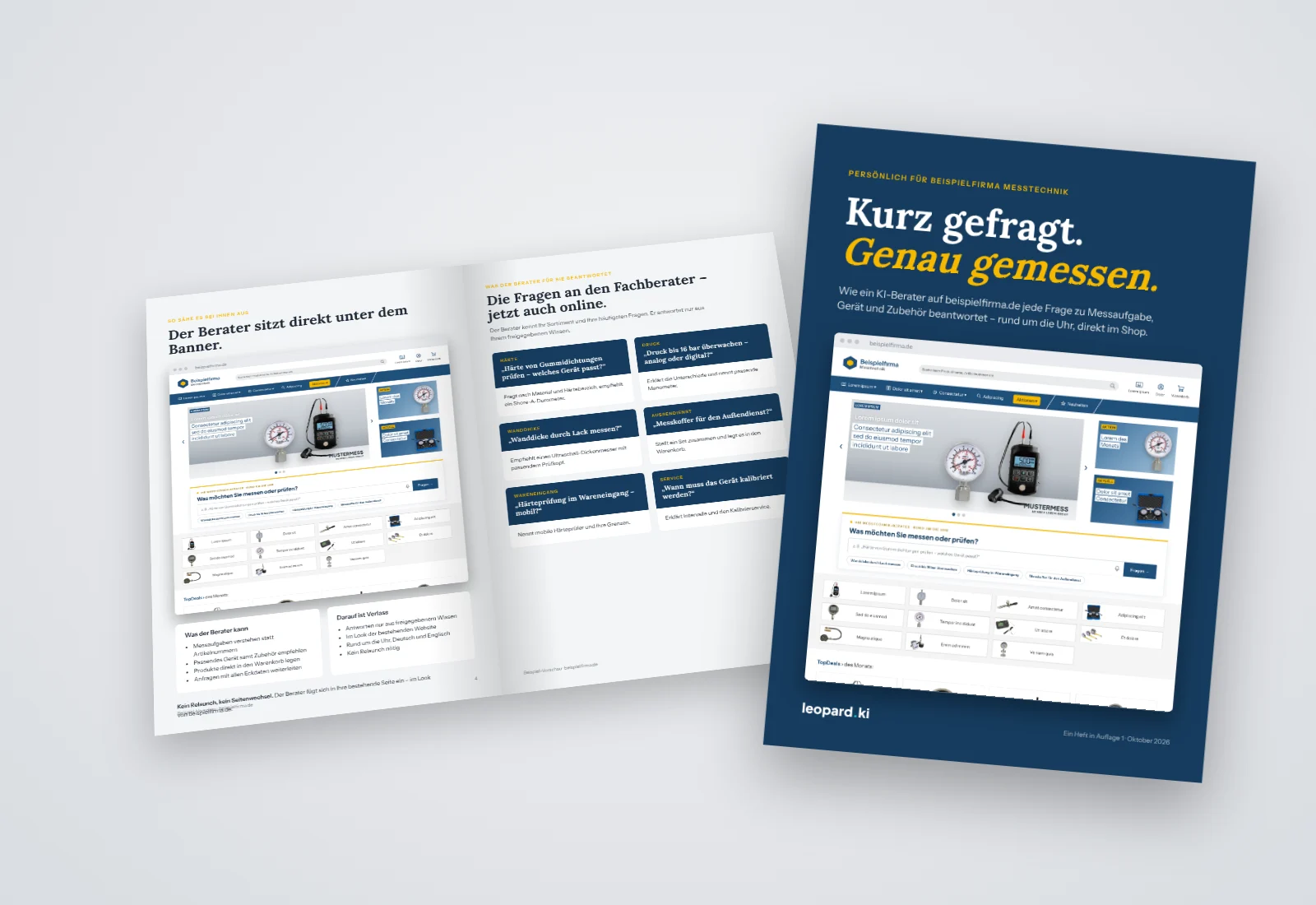
Get a free preview of your own homepage with the advisor field, by email within 3 working days. Or book a demo with a selection of your own products. Both are free and non-binding.