
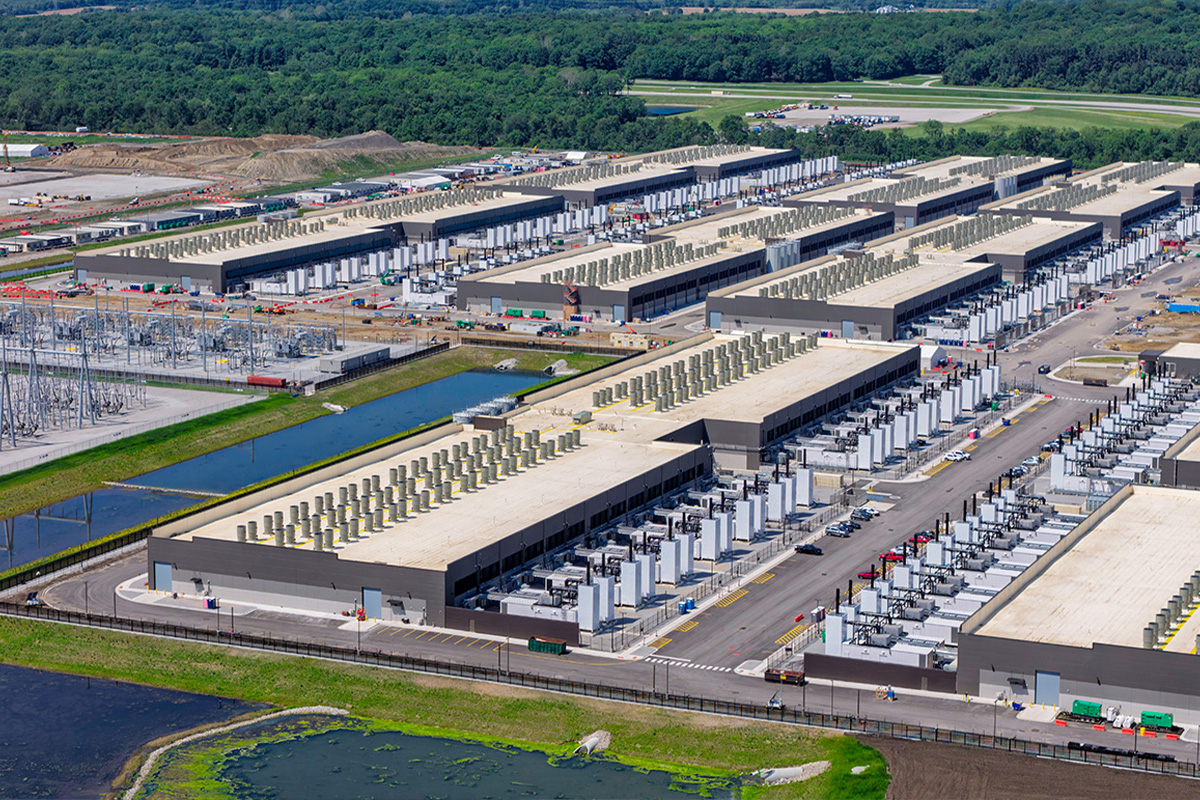

You've probably seen the headlines: tech companies pouring hundreds of billions of dollars into data centers the size of small cities. xAI, OpenAI, Google, Microsoft, Amazon — all racing to build bigger, more power-hungry AI infrastructure. And you might be asking a reasonable question: if language models are already this capable, why do we need facilities that draw as much electricity as entire regions?
It's not surveillance. It's math — an enormous, expensive amount of it.
AI data centers do two distinct things, and each demands a different kind of infrastructure.
The first is training: teaching a new model from scratch by running it through vast amounts of data until its internal parameters converge on something useful. Training requires tens of thousands of specialized chips (GPUs or TPUs) working in tight coordination, connected by ultra-fast networking, because the calculations depend on each other in real time. A single large training run can consume tens of millions of kilowatt-hours — roughly the annual electricity use of several thousand households — and it typically runs for weeks or months without stopping.
The second is inference: actually running the finished model to answer your questions, write your code, or summarize your documents. Each individual request takes only a fraction of the compute a training run needs. But multiply that by billions of requests a day, from businesses and consumers around the world, and the total adds up to another massive, continuous compute load — one that's growing faster than training right now, as more companies put AI into daily use.
Here's the part that surprises most people: the compute needed to train the best available models has been roughly quintupling every year. That's not marketing — it reflects a real, measurable relationship between how much computing power goes into a model and how capable it ends up being. Even though current models are genuinely useful, the next generation reliably performs meaningfully better with more training compute behind it — which is exactly why every major AI lab keeps building bigger clusters rather than declaring the job done.
At the same time, the industry is starting to shift its center of gravity. As adoption grows, the inference side — actually serving all those daily requests — is catching up with training as the bigger long-term driver of data center growth. That means a different kind of infrastructure: smaller, more distributed facilities placed closer to users, rather than a handful of giant, centralized training campuses.
It's a fair thing to wonder about, especially given how much data these systems touch. But the physical reason these facilities are so large has nothing to do with storing or monitoring individual people. They're built to run mathematical operations — matrix multiplications, mostly — at a scale and speed no ordinary computer can manage. Power and cooling, not storage capacity, are what actually limit how big these campuses can get.
That doesn't mean data privacy is a non-issue — it's a real and separate question, and a legitimate one to ask any company you share information with: what happens to your data, where is it stored, and under which country's rules. That's exactly why, at leopard.ki, we host in Germany, hold BITMi's "Software Hosted in Germany" and "Software Made in Germany" certifications, and work with a hand-curated knowledge base instead of routing your customers' conversations through systems you can't see into. Scale and transparency aren't the same thing — and you shouldn't have to trade one for the other.
Get in touch for access or support.
Request a personalized showcase of leo.live, or get your copy of Magazine 2026. Both are free, and neither commits you to anything.