
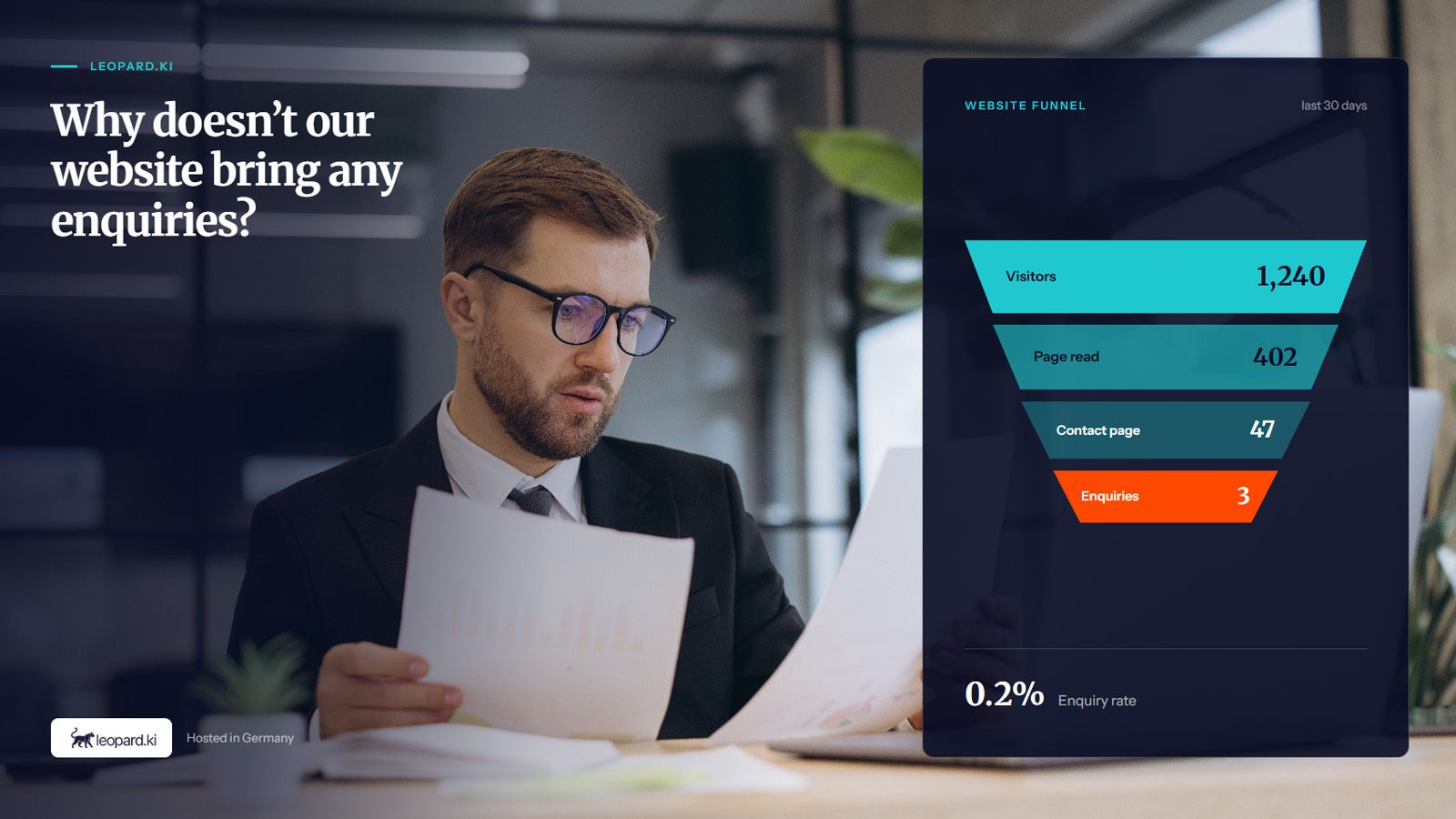

In most cases, the honest answer isn't that your website is missing information — it's that a visitor can't work out, from everything that's already there, which solution fits their specific situation. For technical, engineered products, this is rarely a content problem. It's a decision problem. A visitor reads a dozen spec sheets, understands every one of them individually, and still isn't sure which configuration is right for their application, their existing setup, or their tolerances. That's where the drop-off happens — not at the top of the funnel, but at the exact point where information was supposed to turn into confidence.
The instinctive response to too few inquiries is usually: more visibility, more SEO, a bigger campaign budget. That helps if the actual problem is too little traffic. It does nothing if the problem is structural — if the traffic you already have isn't converting either. More traffic just repeats the same outcome at a larger scale: more people reading, comparing, and leaving without making contact. There's a telling pattern in a recent Gartner survey of 646 B2B buyers (August–September 2025): 67% said they'd prefer a rep-free buying experience. Buyers genuinely want to research independently — that's not a red flag, it's the default now. And yet a companion study from the same Gartner buyer population found that 69% of buyers who used generative AI to research a purchase still wanted to validate what they'd found with a sales rep before moving forward. Independent research and the need for individual confirmation aren't opposites — they usually show up together. Fix visibility without fixing that second half, and what you get is simply more visitors carrying the same unresolved question.
Picture a manufacturer with 18 variants of an industrial pressure transmitter, each documented in detail — full spec sheets, tolerances, wiring diagrams, a datasheet PDF. A visitor works through several of them and understands each one on its own terms. What they still don't know by the end: which of the 18 actually handles their process temperature, their chemical compatibility requirements, and their accuracy class — all at once. The question was never really "what is a pressure transmitter?" — product pages answer that fine. The real question is closer to: "which of these will still be accurate at 180°C in a corrosive line, given what I already have installed?" That's not an information question anymore. It's an application question, and a static product page can't answer it, no matter how well it's written, because it doesn't know the visitor's specific case.
That lines up with what Forrester describes for 2026: generative AI is now often the starting point of B2B research, but it "often deliver[s] incomplete or unreliable information" — and one consequence is that the median buying group has grown to 13 internal stakeholders and 9 external influencers, largely there to de-risk exactly this kind of uncertainty together. The more complex and consequential the decision, the more people get pulled in to do one specific job: translate generic information into a judgment about their own case.
Before anyone in technical purchasing or engineering actually submits an inquiry, they're usually trying to answer for themselves:
A quick distinction is worth making here, since the terms get used loosely: a lead is just a captured contact; an inquiry is someone actively asking about a specific need; a qualified lead is an inquiry matched to a real, serviceable buying scenario; a sales opportunity is a qualified lead with budget, timeline, and authority confirmed. Most of what a complex B2B site is actually short on isn't raw contact volume — it's inquiries that already carry enough context to qualify quickly, instead of generic form-fills that go nowhere.
6sense's analysis of real buying cycles found that buyers typically don't contact a vendor until roughly 70% of an ~11-month buying journey is already behind them — about eight months of independent research first. In 83% of cases, the buyer initiates that first contact, not the seller; proactive early outreach from sales made no measurable difference to that pattern. In practice, that means the website carries the full weight of answering these questions, alone, for months — sales typically only enters the picture afterward.
Different research groups describe roughly the same effect from different angles: Gartner frames it as buyers wanting validation despite preferring self-service, Forrester frames it as buying groups growing to de-risk decisions collectively, 6sense frames it as a long independent-research phase before any seller contact. There's no single established term for it, but call it an advisory gap: the space between information being available and a buyer being able to apply it confidently to their own case. For simple, well-defined purchases, that gap barely exists. For complex, engineered products, it's often the actual reason a well-visited website still isn't generating qualified leads.
For clearly defined, countable criteria — size, voltage, material, certification — product finders and filters are exactly the right tool. They reliably narrow 18 options down to three or four real candidates, and they should be used wherever that's the shape of the problem. Their limit shows up when a case involves several interacting factors at once — environmental conditions, compatibility with an existing installation, and a required accuracy class, all together — or when the visitor doesn't yet know which filter criteria even apply to their situation. A fixed selection menu can only answer questions it was built to anticipate. A conversation can ask a follow-up, react to an unusual answer, and narrow the case down step by step — which is what a good technical sales engineer would do on the phone.
One more factor belongs here, briefly, without making it the whole story: Google's AI Overviews and tools like ChatGPT are increasingly answering general, informational questions directly, with no click to any website at all. SparkToro found that roughly 68% of Google searches in the US ended without a click in early 2026; the independent Pew Research Center, studying roughly 69,000 queries in July 2025, found that users clicked a traditional result only 8% of the time when an AI Overview appeared, versus 15% without one. What that means for B2B websites in more depth is a topic for its own article. For the inquiry question, the relevant point is simpler: as generic "what is product X" questions get answered directly by AI systems, what a company's own website is still needed for shifts — from the informational question toward the more specific one, "is product X right for my case." That effect is well documented for generic US search behavior; for German or European technical B2B niches like machine building or measurement technology, it's plausible but not yet independently measured.
This is exactly where leo.page comes in. Instead of routing visitors through a fixed menu of product pages and PDFs, leo.page turns the website into a dialogue-based advisor: a visitor describes their actual situation in their own words, the system understands the question, asks targeted follow-up questions where needed, draws on the company's curated product and process knowledge, identifies which solutions actually fit, explains the differences between them, and guides the visitor to a sensible next step — a specific recommendation, or a qualified handoff to sales. That's what separates leo.page from a standard FAQ chatbot: it isn't producing pre-written stock answers, it's working through the specific case a visitor just described.
One side effect of these conversations is useful on its own: leo.live analyzes the anonymized dialogue data. That surfaces which questions visitors are actually asking, which topics come up repeatedly, which products generate the most interest, where decision barriers tend to appear, and what information the website is currently missing. That's a different kind of signal than a standard analytics dashboard of clicks and time-on-page — it shows the actual question behind the visit, not just that a visit happened.
So if the problem is rarely a lack of information, and much more often a missing answer to the visitor's specific situation, then the fix isn't another product page or another marketing dollar spent on traffic — it's a website that can actually reason through that specific case. That's what leo.page is built for.
Get in touch for access or support.
Request a personalized showcase of leo.live, or get your copy of Magazine 2026. Both are free, and neither commits you to anything.