
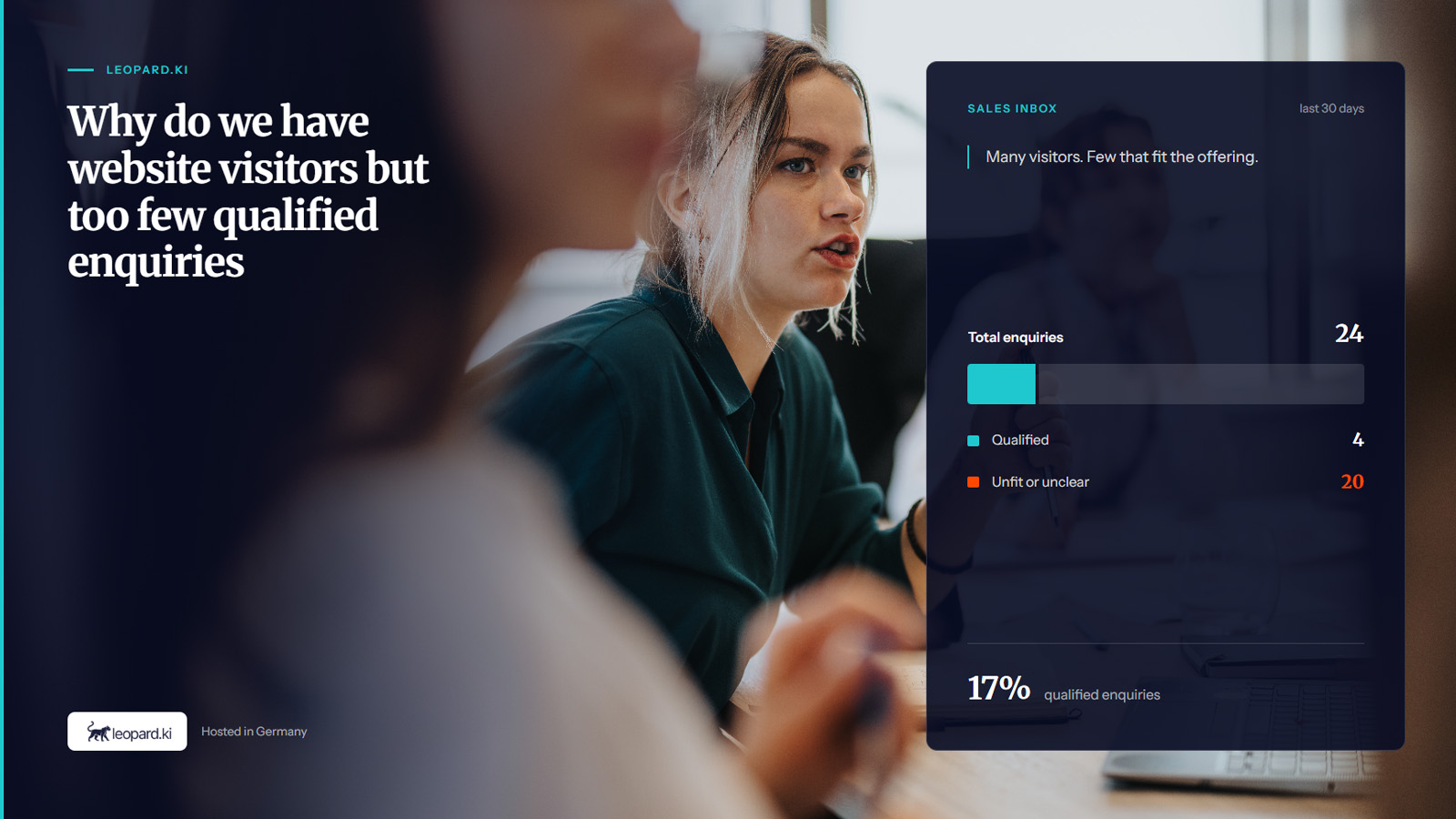

Because traffic and demand are two different things. Visitor numbers measure attention — how many people were on a page and what they clicked. They say almost nothing about what those people were actually trying to decide. A manufacturer with 5,000 monthly visitors usually knows exactly which product pages were viewed, but not which application someone was sourcing for, which alternative they were weighing, or which technical constraint was blocking the decision. That information is precisely what determines whether a visit becomes a qualified inquiry. So the more useful question isn't "how do we get more traffic?" — it's whether you understand the demand behind the traffic you already have.
The term gets used loosely, so briefly and without the marketing-automation vocabulary: a visitor is someone who was on the site. A lead is a captured contact. It becomes qualified only once enough is known about the need to judge whether there's a serviceable case at all. It becomes a sales opportunity when budget, timeline, and decision authority are confirmed on top of that.
For a manufacturer of engineered products, the qualifying attributes that matter are mostly technical: the specific application, the product type needed, technical requirements and limits, the existing equipment or system environment, project stage, timing, and quantity. No company needs to capture all of that through its website. But the less of it is known when an inquiry reaches sales, the more time gets spent establishing it — and the more often it turns out there was no serviceable case to begin with.
First, for a structural reason: the overwhelming majority of visitors never identify themselves. A 6sense survey of 169 B2B marketing professionals found form fill rates of 3–3.5% of unique website visitors — meaning roughly 97% of traffic stays anonymous. That figure is from 2022; current vendor benchmarks land in the same 96–98% range, though on aggregated data with weaker documented methodology. The order of magnitude holds either way: the filled-in form is the exception, not the norm. This is the gap usually described as the dark funnel — buying activity that happens without any identifiable trace.
Second, for a substantive reason: even where behaviour is measured cleanly, it stays ambiguous. A visitor reads three pages about a measurement system and stays four minutes. That could mean an active sourcing project, early technical research with no budget attached, a competitor doing market analysis, a student writing a thesis, an existing customer hunting for a datasheet, or an employee looking something up internally. A clickstream cannot reliably separate those six cases. Reading buying intent out of dwell time or page depth usually means reading in more than the data supports.
None of which makes analytics weak. They answer a whole class of questions reliably and better than any alternative: where visitors come from, which campaigns work, which landing pages carry their weight, where people drop off, which devices and regions dominate, whether technical problems are breaking the funnel, and how all of that trends over time. For steering marketing spend and site structure, that data is indispensable.
The limit sits elsewhere. Analytics answer what happened very well. They aren't built to answer what was this visitor trying to find out. That isn't a flaw in the tooling — it's a property of the data type. Behavioural data records actions, not intentions.
Signal by signal, with what each does and doesn't support:
The contrast makes it concrete. Analytics give you: product page viewed, 3:42 on page, two further pages, no form submitted. A question asked in a conversation gives you: "We need a measurement system for a machine tool with 6 m of travel, we require ±0.02 mm/m, and we're currently comparing two vendors."
The second record contains application, technical requirement, scale, and competitive context — none of which exists in a clickstream. Questions with similar density show up constantly in technical B2B:
Each of these carries at least one qualifying attribute: an application, a technical constraint, a decision criterion, sometimes a signal about urgency or plant size. The caveat matters: a question like this still doesn't prove buying intent. It does provide far more context than ten page views — and context is what makes qualification possible in the first place.
That decision clarity has commercial consequences is supported by Gartner research among 646 B2B buyers (August–September 2025): buyers with high decision confidence are twice as likely to report a high-quality deal as buyers with low confidence. A second Gartner survey of 632 buyers (August–September 2024) adds to the picture: 74% of buying teams experience unhealthy conflict during the decision, and groups that reach consensus are 2.5x more likely to report a high-quality deal. Both findings are about deal quality, not website traffic. But they point at where the leverage sits: not in the number of visits, but in how clearly a decision gets prepared.
Partly, and it's worth being fair about it. There's an established toolset aimed at exactly this gap. Reverse IP lookup and visitor identification attribute anonymous traffic to companies. Third-party intent data providers flag when research activity around a topic spikes inside an account. Account-based marketing prioritises target accounts. Marketing automation and behaviour scoring weight actions over time. CRM data supplies history. These approaches aren't hollow — they answer real questions, often well.
What they mostly answer, though, is a who question: which account is showing activity right now, and how much. The technical what — which application, which requirement, which alternative, which obstacle — largely stays open. For a standard product, knowing the who is often enough. For a configurable measurement system with twenty variants, the what determines whether an inquiry is workable at all. The two layers aren't in competition; they answer different questions.
Several sources already exist inside most companies and go unanalysed: on-site search queries, free-text fields in contact forms, recurring questions in sales calls, support tickets, questions coming through distributors. All of them carry real customer language rather than guessed-at keywords. The drawback is that they either appear late in the process or arrive in volumes too small to see patterns in.
When a company starts collecting and analysing these questions systematically, the result is sometimes called demand intelligence — a term used with varying scope by different vendors and without a single established definition. What's meant here specifically: a more direct picture of what the market actually wants to know, compare, and decide, derived from what prospects state themselves rather than from what a keyword tool suggests.
The value isn't confined to sales. Marketing learns which content is missing. Product management learns which applications and requirements come up repeatedly — and which limits turn into problems again and again.
And underneath all of it: can you say today what your visitors are actually trying to decide — or only what they clicked?
This is where leo.page fits, with a deliberately modest claim. A dialogue-based AI advisor on the site lets a visitor state their actual problem in their own words instead of assembling an answer from a menu structure. In doing so, information surfaces that clickstream data doesn't contain: the specific application, the technical requirement, the alternative under consideration, the concern holding the decision up. That isn't mind-reading and it isn't a purchase prediction — it's simply a better starting signal than a page view.
leo.live analyses those conversations. Each question is classified by substance — as a buying signal, a barrier to purchase, a technical question, a trust question, or a product-understanding question — and weighted by relevance. Across volume, clusters emerge: which questions recur, which topics are newly appearing, which terms prospects actually use, and where information is repeatedly missing with no page yet covering it.
So if you want to know not just which pages your visitors open but which questions and decisions sit behind them, the conversations on your site provide an additional layer of data — and leo.live makes the patterns in it visible. Traffic is attention. A specific customer question is context. For manufacturers of engineered products, the second is usually the scarcer of the two.
Get in touch for access or support.
Request a personalized showcase of leo.live, or get your copy of Magazine 2026. Both are free, and neither commits you to anything.