
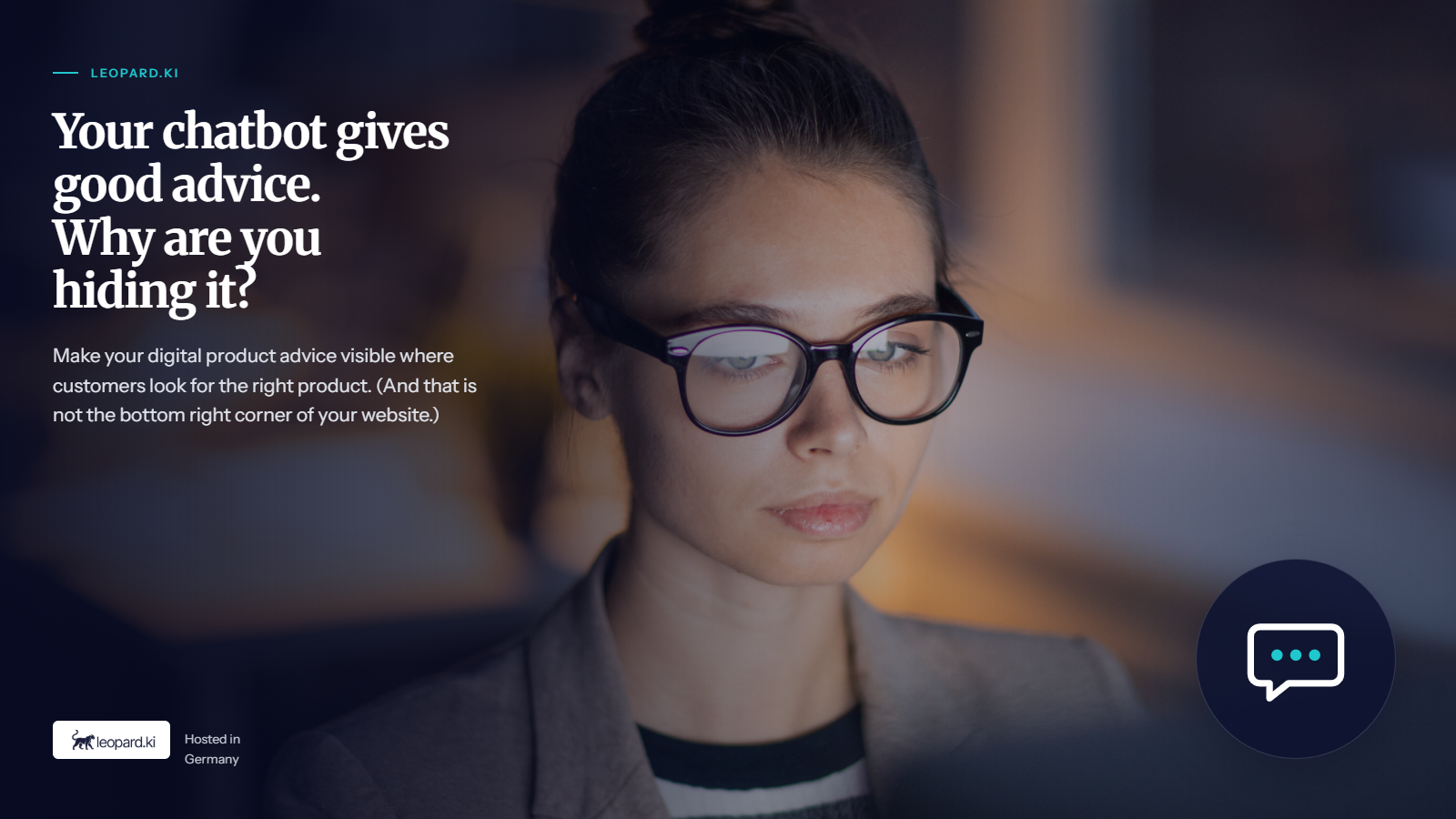

You pay for a chatbot. You maintain content, set up answers and hope for more inquiries. In the bottom right corner, a friendly robot blinks.
The invoice arrives like clockwork. Do the customer inquiries?
A chatbot is quick to install and easy to show off. Its value still has to be proven. If it neither helps customers nor takes work off your sales team, and never justifies its cost, it is money down the drain. Even if it says “AI” on the label.
For complex products in particular, one uncomfortable question is worth asking: Have you created advice that actually helps – and can your visitors even find their way to it?
The chat provider Smartsupp has published data for 2024 covering around 4.8 billion website visits and more than 175,000 accounts. It reports live chat usage of 0.84 percent. The roughly 40 million conversations it lists work out to about 0.84 conversations per 100 visits. [1]
That is a strikingly low rate. However, it shows neither how many people opened the chat window nor how many saw it. And it is not a general benchmark for AI chatbots in technical B2B sales.
Turning it into “99 percent ignore every chatbot” overstates the case.
What the number does justify: look at your own data. How many of your potential customers use the advice you offer? And what comes of it?
Because even a few conversations can be valuable. In mechanical engineering, a single additional, well-matched inquiry can make a considerable difference. A rarely used chat is therefore not automatically unprofitable. But an ineffective chat doesn't become valuable just by being there.
At a trade fair, you would hardly put your product specialist behind a partition wall and hope interested visitors find them anyway.
On a website, though, a small circle in the corner is supposed to be enough. Maybe with “How can I help?” next to it. What exactly it can help with, the visitor has to work out alone.
That is a weak invitation for someone preparing a demanding purchase decision.
In 2026, the Nielsen Norman Group examined eight website chatbots in qualitative tests with nine people. Participants overlooked the offers or didn't recognize what they were for. This is not a representative usage statistic, but it is a concrete indication of problems with findability and communication. [2]
The consequence for design: say explicitly what job your advice does. “Find the right measuring system” gives a prospect a clearer reason to start than “Start chat”.
A prospect looking for measurement technology might ask:
“Which system is suitable for our component, this tolerance and the conditions in our production?”
If you sell machinery, you know questions about throughput, footprint and interfaces. If you offer lifting equipment, you have to clarify load capacities, geometries and operating conditions.
Digital advice can make sense for decisions like these. Provided it works with reliable product information, asks for missing details and makes the limits of its answers clear.
A bot that merely repeats paragraphs from the website, on the other hand, has to face a simple question: Why should a visitor start a conversation for that?
The Nielsen Norman Group describes this difference as well: answers to specific product questions and follow-up questions about individual requirements were helpful. Chats that recreated existing search and filter functions in a more cumbersome way were less convincing. The recommendation is to make advice visible in the right context and to name its benefit concretely. [2]
Name, color and avatar are quickly decided. The harder questions sometimes remain open:
Which purchase decision should the advisor make easier? What information is the prospect missing? When does a human need to take over? And how do we know the offer is delivering anything?
A friendly face doesn't solve these tasks. Whether your advice is helpful depends on its answers and on the next sensible step for the customer.
That is also why the blanket claim “chatbots don't work” is misleading. In 2020, Clearbit described a single B2B case that started with 0.1 percent chat usage. After personalization, the rate reportedly rose sixfold and generated an additional 600,000 US dollars in sales. This is a vendor report, not general proof of effectiveness. But it shows why you shouldn't quote only the poor starting figure. [3]
What matters is the specific implementation. Every offering has to be measured by that, ours included.
That is why leo.page relies on a standalone advisory page. It can be linked exactly where a product question arises. Based on your product information, it can ask follow-up questions and help prospects prepare a concrete inquiry.
The entry point might look like this:
Smart Links make it possible to start with a relevant question on a specific topic. The visitor gets a concrete starting point for the conversation.
This is our approach to making advice visible and accessible. Whether it generates more helpful conversations and better-matched inquiries on your website has to be shown by actual use. A dedicated page alone does not guarantee success.
For an initial assessment, you don't need an arbitrary three-percent mark. You need answers to five questions:
Count openings and conversations separately. An opened speech bubble is not yet advice. And a contact who would have ordered anyway is not automatically additional revenue generated by the chatbot.
If the entry point is hardly used, test a concrete invitation directly within the relevant page content. Compare what changes under conditions that are as similar as possible. Then also check whether the conversations get better and actually help the customer move forward.
A chatbot earns its place on your website when it helps your customers and delivers a traceable benefit to your company.
If that benefit stays below the effort over time, you should improve the offering or end it. Another mascot and a friendlier greeting will hardly save the bill.
Anyone paying for digital advice every month should get more than a blinking circle.
Otherwise, it really is: money down the drain.
Would you like to see how leo.page can support advice on your products? Let's talk about a concrete customer question in a 15-minute online presentation.
[1] Smartsupp: Analysing 5 billion website visits: How e-commerce customers use chat. Data year 2024; accessed 30 Sep 2026. Vendor analysis of live chat and chatbot conversations, not a general click statistic for AI chatbots. https://www.smartsupp.com/blog/analysing-5-billion-website-visits-how-ecommerce-customers-use-chat/
[2] Nielsen Norman Group: What Is Your Site's AI Chatbot for? Users Can't Tell. 20 Mar 2026. Qualitative study with nine participants and eight website chatbots. https://www.nngroup.com/articles/site-ai-chatbot/
[3] Clearbit: The B2B Playbook for Personalizing Chat. 17 Mar 2020. Single case report by a vendor. https://clearbit.com/blog/b2b-chat-personalization-playbook
Get in touch for access or support.
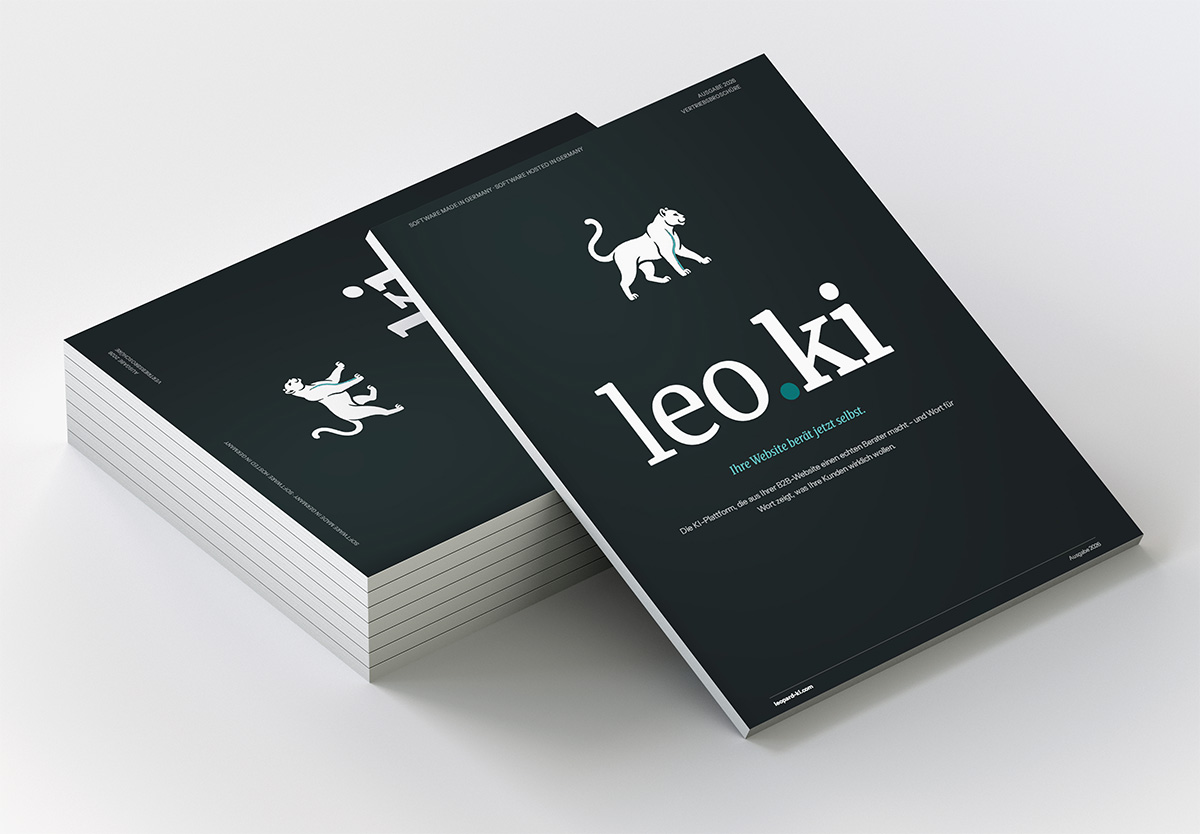
Request a personalized showcase of leo.live, or get your copy of Magazine 2026. Both are free, and neither commits you to anything.