
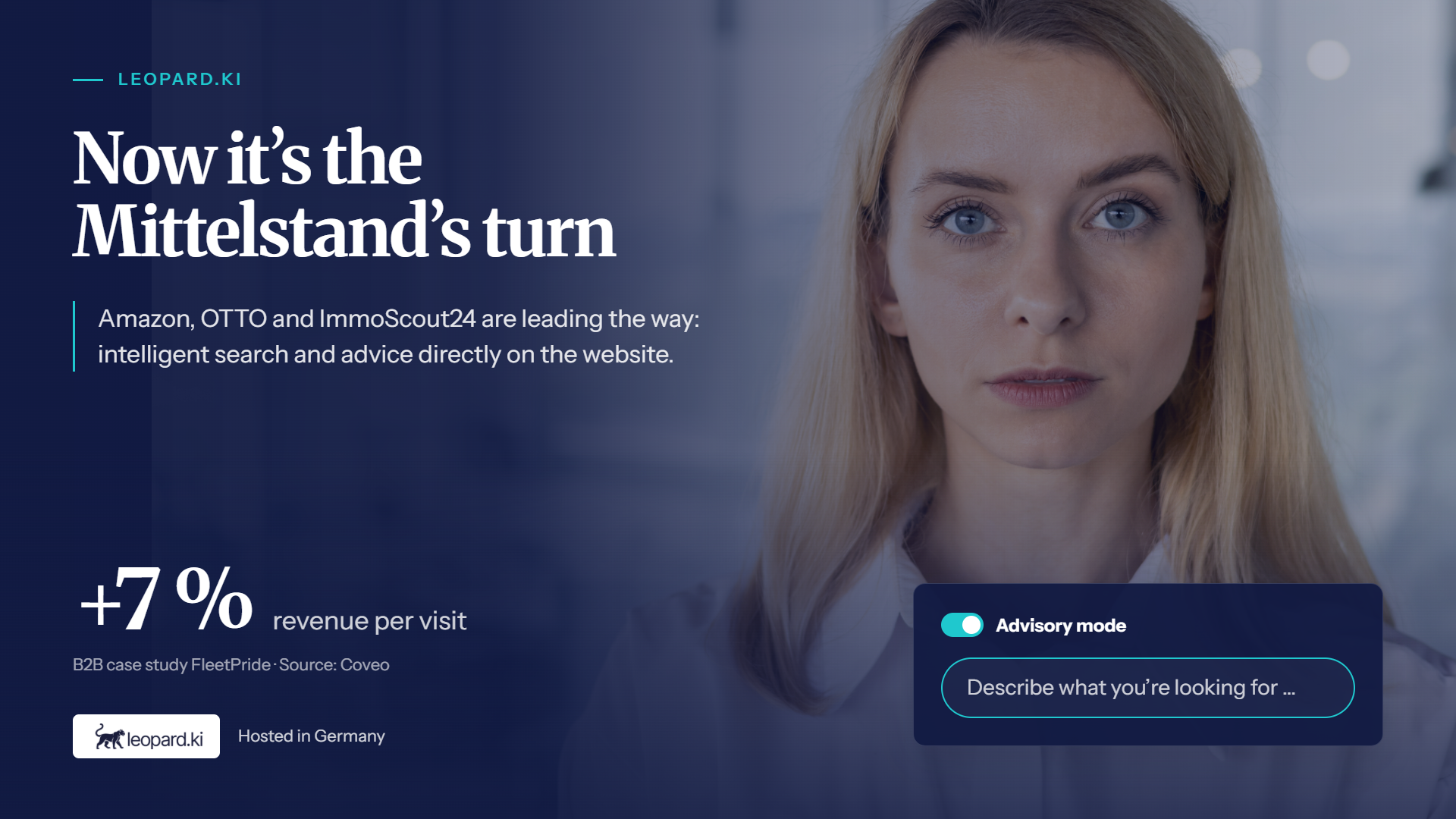

People looking for a product don't necessarily know what it's called. In technical B2B in particular, prospects can often describe their task more precisely than the machine, measuring instrument or adapter that solves it.
Yet that is exactly what many websites demand: visitors are expected to know the right search terms, understand product categories and pick technical filters on their own.
Intelligent product search starts earlier. The customer describes what they need. The website helps them find the right solution. Large platforms and retailers are already rolling out features like this. Early results show that better product selection can translate into more inquiries and higher conversion rates.
At ImmoScout24 Switzerland, the entry point is called “Intelligent Search”. Freely worded housing wishes are translated into matching search filters. A dialogue function added since then lets users refine their requirements and ask follow-up questions. [1]
AutoScout24 Switzerland invites visitors in its search area to “Describe what you're looking for.” [2] Booking.com calls its approach “Smart Filter”. Users describe the accommodation they want; the AI maps it to the relevant filters. [3]
The names differ. What they share is an offer that's easy to understand: describe what you want, and we'll help you choose.
For technical products, such an input might read:
“I need a measuring device that lets me check the inclination of a machine in a tight space.”
Helpful advice then clarifies the decisive points: What accuracy is required? How much space is available? Under what conditions will the measurement take place? Only then does a sensible product recommendation emerge.
For its AI shopping assistant Rufus, since renamed “Alexa for Shopping”, Amazon publishes a striking figure: according to Amazon, customers who use it while shopping are more than 60 percent more likely to complete a purchase. [4]
That is not proof of a blanket 60 percent revenue increase from AI. The figure compares users of the assistant with non-users. People with a concrete intention to buy may be more likely to use the advice in the first place. Still, it shows how closely digital advice and purchase decisions are now connected.
AutoScout24 Germany reports around 7.5 percent more leads from search in tests of its new AI vehicle search. The basis is a connected data structure that links vehicle attributes, search queries and listings more precisely. At publication in September 2026, a dialogue assistant was announced as the next step. [5]
The example makes one thing clear: the benefit comes not only from a new interface, but also from a more precise understanding of the products and their properties.
For B2B companies, experiences with complex product ranges are particularly interesting:
FleetPride is especially illustrative. Customers previously often needed an exact part number to order online. In a range of more than one million parts and accessories, that is a considerable hurdle. AI-powered search improves access to the right products.
At Boston Scientific, the relevance of search results was optimized using machine learning. Swedol improved speed, relevance and the display of customer-specific assortments, among other things. Swedol serves both business and private customers; the published results are not broken down by these groups.
The figures come from case studies by the technology vendors or implementation partners. They are not independent industry averages. They also refer to different measures and metrics. “Conversion” doesn't mean the same thing in every case study, and the increases can't automatically be equated with more qualified inquiries.
They do, however, provide concrete indications that better digital product selection is economically relevant in technical trade as well.
A search function works well when visitors already know what to search for. With complex products, that is often exactly what's still open.
This calls for follow-up questions, clear explanations and a comparison of suitable solutions. Intelligent search can therefore be the entry point to advice: first capture the need, then clarify missing information and recommend suitable products.
For technical B2B companies, this raises a practical design question: where can a prospect express their need most easily?
A visible input field on the homepage or in a product category can provide an easy-to-understand entry point:
Describe your application. We'll help you find the right product.
Whether this placement works better than a small chat window at the edge of the screen has to be measured in each case. The case studies above don't compare these placements directly. But they do show that it pays to deliberately improve access to product selection.
With leo.page, we at leopard.ki address exactly this task: prospects describe their need, the AI product advisor asks targeted follow-up questions and supports the selection based on structured product information. This can lead to concrete inquiries that give sales a better-prepared starting point.
What matters is that the advice is offered visibly and reliably draws on the actual products. That includes clear information on technical properties, application limits and compatibility.
Success should show in the right metrics:
Other companies' results are a good reason to examine this approach. What it delivers for an individual company is shown by its own data.
Your customers know their task. Help them find the right product.
Find out how leo.page can support product selection on your website.
As of 2 October 2026. The sources contain self-reported figures from the vendors and implementation partners involved.
[1] Swiss Marketplace Group: ImmoScout24 AI search (23 Mar 2026) and dialogue-based property search (21 May 2026). https://swissmarketplace.group/media-release/immoscout24-ai-searches-03-2026-en/ · Media release 21 May 2026 (PDF)
[2] AutoScout24 Switzerland: search area with “KI Suche” (AI search); accessed 2 Oct 2026. https://www.autoscout24.ch/
[3] Booking Holdings: Booking.com Enhances Travel Planning with New AI-Powered Features (Smart Filter). 30 Oct 2024. https://www.bookingholdings.com/press-releases/booking-com-enhances-travel-planning-with-new-ai-powered-features-for-easier-smarter-decisions/
[4] Amazon: Amazon's next-gen AI assistant for shopping. 18 Nov 2025, noting the renaming to Alexa for Shopping (13 May 2026). https://www.aboutamazon.com/news/retail/amazon-rufus-ai-assistant-personalized-shopping-features
[5] AutoScout24 Germany: AutoScout24 startet neue KI-Fahrzeugsuche. 14 Sep 2026. https://www.autoscout24.de/unternehmen/corporate-meldungen/autoscout24-startet-neue-ki-fahrzeugsuche/
[6] Coveo: Leading Brands Use Coveo AI to Transform their Ecommerce Product Discovery (FleetPride). 22 May 2025. https://ir.coveo.com/en/news-events/press-releases/detail/438/leading-brands-use-coveo-ai-to-transform-their-ecommerce
[7] Smith: Boston Scientific – Transforming Product Discovery with AI-Powered Search. https://smithcommerce.com/our-work/case-studies/boston-scientific/
[8] Algolia: Swedol customer story. https://www.algolia.com/customers/swedol
Get in touch for access or support.
Request a personalized showcase of leo.live, or get your copy of Magazine 2026. Both are free, and neither commits you to anything.