
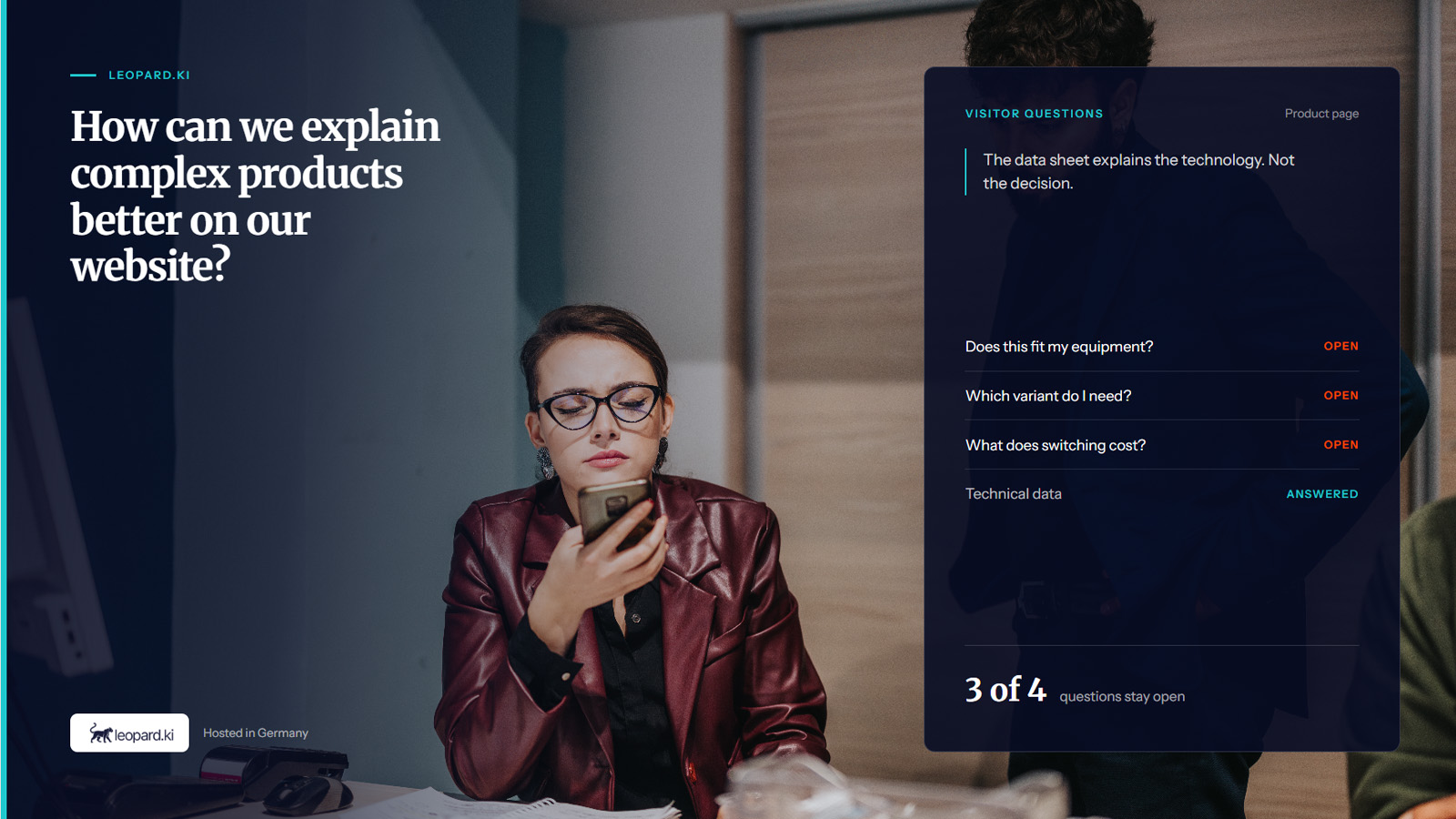

Usually not by writing more. With technical products, the problem is rarely that too little is on the website. It's that the customer has to work out, from a lot of correct information, which parts matter for their case. A product page explains a product. Advice explains which product fits this particular customer. Those are two different jobs. Most websites only do the first one. So if you want to explain complex products better, spend less effort on the copy and more on one question: how does a customer get from their problem to the right product?
Because good information and good decisions are not the same thing. There's a striking figure on this. In Gartner research covering more than 1,000 business buyers, 89% said the information they found during their buying process was high quality. The material wasn't the problem. Many of them still struggled to reach a decision. And according to the same research, buyers who ran into too much good but conflicting information were far more likely to settle for something smaller and safer than they had originally planned.
For a manufacturer, that's the more uncomfortable finding. Too much information doesn't necessarily stop the purchase. It shrinks it. When in doubt, the buyer picks the option they're least likely to get wrong — not the one that fits best. The study is from 2019, so it isn't new, but it remains one of the most cited pieces of work on this point.
No — and that matters before anyone starts cutting their range. The familiar line that "too much choice paralyses people" doesn't hold up as a blanket rule. A review of 50 experiments with just over 5,000 participants found essentially no average effect. More choice, on its own, is not the problem.
The interesting question is when it does become one. A second large review, covering 53 studies with around 7,200 participants, looked at exactly that. Four conditions make the difference. Choosing gets hard when:
One finding from that review gets to the heart of it: people who are unfamiliar with a product category are more likely to postpone the decision when the range is large. People who know the category well actually benefit from a large range.
That explains something most sales managers recognise. The long-standing customer who has known the series for years handles 25 variants without trouble. The new prospect, buying this kind of equipment for the first time, gets stuck — and never gets in touch. The number of products isn't the problem. The problem is that they don't yet know their own requirements.
A simple distinction helps here.
Product information answers: what is this? What are the specifications? Which variants exist? Which standards does it meet? What does it cost?
Product selection answers: which of these fits my situation? Which variant do I need? Out of all these specifications, which ones actually decide it for me? What won't work in my case? Which accessories go with it?
Most technical websites are good at the first job. Datasheets, drawings, performance figures, PDFs — all there and usually well maintained. They're considerably weaker at the second. That's where the customer gets stuck.
A manufacturer offers six measurement systems. For each one the website lists measuring range, accuracy, resolution, temperature range, interfaces, accessories. All correct. All complete.
An experienced application engineer on the phone would still start somewhere else entirely. What exactly are you trying to measure? How big is the machine? What accuracy do you actually need? Under what conditions — workshop, plant floor, temperature swings? What happens to the readings afterwards?
Only then does a recommendation follow. And often they'll also say what they would not recommend, and why.
That's the difference between data and advice. Your best salesperson doesn't just know what a product can do. They know when they'd recommend it — and when they wouldn't. That knowledge is rarely written down in a datasheet. It sits in people's heads.
The same pattern shows up across technical B2B. The customer isn't looking for "pump type XYZ" — they need a pump for their medium, their head, their temperature. Not "lifting beam model 4711" — a safe way to lift a 4.5-tonne component. Not "sensor series AB" — something that works reliably on their surface at their distance. The website starts with the product name. The customer starts with the job.
Often completely enough — and in those cases they beat anything more elaborate. A filter or product finder works well when:
"Pick a diameter → pick a load rating → three matching products." That's fast, reliable and pleasant to use. Where it works, nothing more is needed.
The limit lies elsewhere. A filter assumes the customer already knows what to filter by. Should they filter by measuring range? Resolution? Housing type? Interface? Someone who isn't sure gets nowhere, even with an excellent filter. They just see a list of fields they can't fill in.
That lines up with the research above: as soon as the customer doesn't yet know their own requirements, more choice doesn't help — however well it's sorted.
It's worth keeping the options apart, because they don't solve the same thing.
The first three are basics and almost always worth doing. The fourth becomes interesting when several requirements interact and the customer can't yet name them.
Partly, yes. The difference from navigation and filters is the direction. A filter asks first about a product attribute. A conversation asks first about the job.
In practice it looks like this. The visitor writes that they need to align a seven-metre machine tool, and states the accuracy required. Targeted follow-up questions come back — about conditions on site, about what happens to the readings. Only then does a recommendation follow, with the reasoning, and with what doesn't fit.
The key point: the customer doesn't have to understand how the manufacturer has organised its range first. They get to start with their problem.
Another finding from the same Gartner research fits here. Sellers who actively helped their customers sort through and make sense of information closed deals that buyers later rated as good and regret-free in 80% of cases. The lever wasn't more information. It was help making sense of it.
No, and nobody should claim it does. Special designs, project engineering, pricing conversations, risk assessment, long-standing customer relationships — that stays human work, especially in machinery and plant engineering.
The realistic benefit is different. The conversation doesn't start from zero. The prospect has already put their problem into words, seen suitable options and cleared the basic questions. Your sales team joins where it gets technically interesting — instead of explaining, for the fourth time that day, which series covers which standard case.
And the one question that covers all of it: can your website tell a new customer which product fits their case — or does it only show them which products you have?
General questions like "what is an inclination measuring device?" are increasingly answered by Google or ChatGPT before anyone reaches your site. That shifts the job of your own website. The general explanation is available elsewhere. What people come to you for is the more specific question: which device do I need for my application?
That's where leo.page fits. Visitors describe their application in their own words. Depending on how well the company's product and application knowledge has been captured, the advisor can interpret the question, ask targeted follow-ups, select suitable products, explain differences, show alternatives, name limits, and point to a sensible next step. What gets said in those conversations can be analysed with leo.live — showing which questions really come up, and where something is still missing on the site.
No system finds the perfect product every time, and none replaces an experienced application engineer. But if your customers currently have to piece together what suits them from product pages, datasheets and filters, an advising website can take on part of that work. leo.page doesn't start with the product name. It starts with the customer's question.
Get in touch for access or support.
Request a personalized showcase of leo.live, or get your copy of Magazine 2026. Both are free, and neither commits you to anything.