
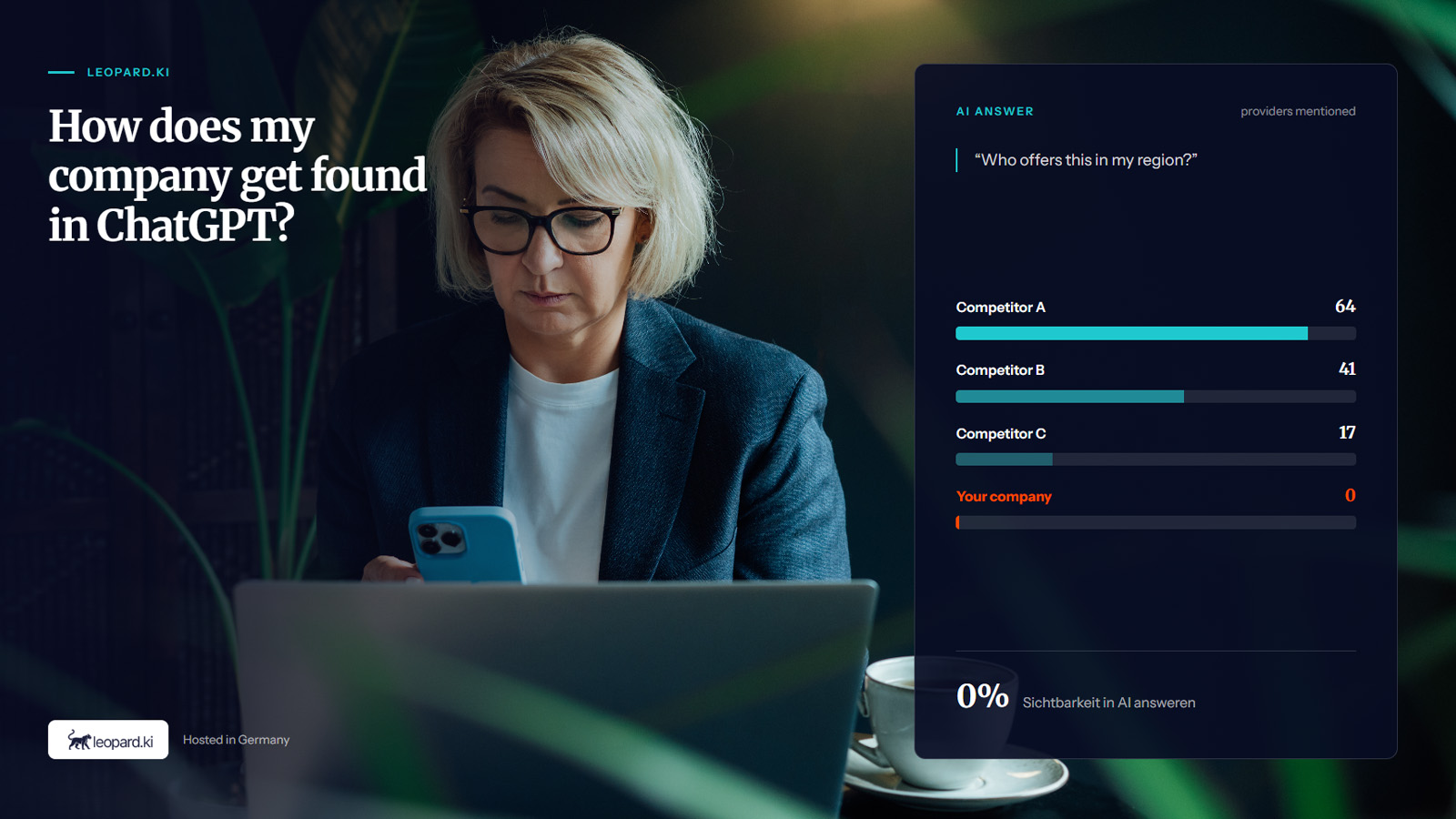

Short answer: your company can, in principle, always show up in ChatGPT — but no one, including OpenAI, can guarantee a top placement or a specific mention. What you can actually influence comes down to three separate things: whether ChatGPT can technically reach your website at all, whether your content makes it unambiguous what your company is actually relevant for, and whether there's credible confirmation of that relevance somewhere other than your own site. All three matter together. None of them is a single trick, and none of them is a text file.
Yes. ChatGPT Search can pull in live web results when a question calls for it. Per OpenAI's own announcement, this isn't built entirely in-house: "ChatGPT search leverages third-party search providers, as well as content provided directly by our partners." For discoverability, one system matters most: OAI-SearchBot, the crawler that indexes websites specifically for ChatGPT's search features. That's distinct from GPTBot, which gathers content for model training, and from ChatGPT-User, which carries out user-triggered actions and, per OpenAI, isn't always governed by the same robots.txt rules.
OpenAI states plainly in its Publishers and Developers FAQ: "Any public website can appear in ChatGPT search." For that to work, OAI-SearchBot needs to not be blocked — the most common accidental cause is an overly broad robots.txt rule, or a firewall/CDN that blanket-blocks unfamiliar bots. One nuance worth knowing: even a page that's disallowed for OAI-SearchBot can still surface as a bare link and title if it's discovered through third-party sources or other crawling. To actually prevent that, OpenAI says you need a noindex meta tag — which, in turn, the crawler can only read if the page remains accessible in the first place. A quick self-check: open your own robots.txt and look for "OAI-SearchBot" under any Disallow rule, and check whether your CDN or a security plugin is blocking unfamiliar crawlers by default.
Two things are worth keeping separate here. The general language model behind ChatGPT only "knows" your company from training if GPTBot was allowed to crawl your pages in the past and that content actually became part of the training data — something you can't force or reliably verify after the fact. Independently of that, your company can still be surfaced through live search whenever a user's question triggers a web search and OAI-SearchBot can reach and read your page at that moment. The two channels are technically separate.
The term gets used constantly, but it's misleading if it implies a separate rulebook with its own tricks. What's actually changed is the sequence of events. Classic Google search: a user searches, gets a results page, clicks. ChatGPT Search: a user describes a problem in their own words, the system interprets the intent, researches if needed — independent analyses have observed it rewriting a single question into several targeted search queries internally, apparently to validate a claim before stating it — and produces an answer with selected source references. What stays the same: publicly reachable, well-structured, technically sound content was the foundation of good visibility before, and it still is. What's different: ranking for a keyword isn't enough anymore — content has to actually answer a real question, or it simply isn't a candidate to be used as an answer source at all.
This is where a distinction gets underestimated in practice. A manufacturer whose website says "50 years of quality and innovation" is saying very little, content-wise, about which specific buyer question that company is the right answer to. A sentence like "we build precision alignment systems for calibrating CNC machine tools to within 5 microns" is far more unambiguous — it maps cleanly to a question like "what measurement system can I use to precisely align a machine tool?" Clear statements about product, application, industry, the problem being solved, and typical comparison criteria help any search or answer system — Google included, not just ChatGPT — connect a piece of content to a user's question. It's worth being precise here: this isn't an officially confirmed ChatGPT ranking rule. It's a plausible conclusion, drawn from how language models work and from long-standing information architecture practice — essentially the same logic a person uses when deciding whether a page actually answers their question.
Even with a technically reachable, unambiguously described website, a third question remains open: why would ChatGPT cite your company specifically? OpenAI doesn't publish a detailed list of official ranking factors — that's worth stating plainly rather than glossing over. What can be drawn from outside observation and independent analysis (not from OpenAI itself): systems like ChatGPT appear to validate a claim before recommending it, and in doing so, visibly look for comparison data, trade coverage, customer reviews, and mentions on independent sites — not only the company's own website. A small, non-representative round of interviews with industrial manufacturers (Gorilla76, 2026) found something similar: the most common gaps were either the absence of directly answerable, specific content on the company's own site, or a lack of credible third-party confirmation — trade press, distributor and partner pages, verifiable customer references. That's a plausible pattern, not an OpenAI-confirmed fact. What can be said with more confidence: statements a company makes only about itself ("we're the market leader") carry visibly less weight in practice than information confirmed consistently across several independent sources.
This is where a lot of agency-blog claims don't hold up under scrutiny. Two are worth checking directly:
llms.txt: This is a text-file format proposed in 2024 by the platform Answer.AI, meant to give an AI system a compact map of a site's content — it isn't an official web standard, and no major AI provider has officially confirmed supporting it. In June 2026, Google updated its official Search Central documentation to state plainly: "You don't need to create new machine readable files, AI text files, markup, or Markdown to appear in Google Search (including its generative AI capabilities), as Google Search itself doesn't use them," adding that creating one "won't harm (nor help) your visibility or rankings […], as Google Search ignores them." There's no equivalent official statement from OpenAI either way; our research turned up no publicly verifiable evidence of a visibility or citation benefit from llms.txt in ChatGPT specifically.
Schema markup: A study by Ahrefs (1,885 pages that added schema markup, tracked against 4,000 control pages, August 2025 to March 2026) found no measurable citation lift in ChatGPT — the change was +2.2%, statistically indistinguishable from noise. That doesn't make clean markup worthless — it still supports technical clarity and, in some cases, classic search results — but it isn't a confirmed lever for more ChatGPT citations.
The same Google documentation also directly pushes back on the claim that AI systems prefer short paragraphs or a specific word count: "There's no requirement to break your content into tiny pieces for AI to better understand it." As a general rule: what GEO guides present as a rule is usually either a reasonable guess or a claim with no real evidence behind it — and both should be kept clearly separate from what OpenAI or Google actually confirm officially.
A simple, free method: write out 10 to 15 real questions the way an actual buyer would ask them, without mentioning your own company name — for example, "which vendors offer automated plate-mounting systems for flexographic printing with frequent job changeovers?" or "what precision measurement system works best for aligning a CNC machine tool?" Run those through ChatGPT and check: does your company come up at all? Is your website cited or linked as a source? Which competitors show up instead, and what external sources does the answer draw on? Which questions surface your brand, and which don't?
One caveat matters for interpreting the results: ChatGPT's answers aren't a fixed, reproducible leaderboard. They can vary by exact phrasing, timing, the mode used, and which sources happen to be available at that moment. A single query is a snapshot, not an objective ranking — run the test a few times over a stretch of days before drawing conclusions from it.
Based on the research, a realistic checklist — with no guarantees attached:
That last point — answerable content built around real questions instead of guessed-at keywords — is exactly where one part of leopard.ki fits in. Through leo.page, visitors already ask real questions about applications, products, variants, and buying decisions today, in a conversation rather than through a static form. leo.live analyzes those anonymized conversations and surfaces which questions actually come up, which problems recur, and what information the website is currently missing. Worth being precise here too: leo.page doesn't guarantee an improved ChatGPT ranking, and leo.live doesn't automatically get a company mentioned in ChatGPT's answers — no one can honestly promise that. What it does produce is real questions as the basis for public, unambiguous content — exactly the kind of content that, based on everything covered here, helps both people and search systems connect a company to the question it actually answers. Visibility in AI search starts with clear, specific answers to the questions customers are actually asking — not with a single technical fix. Whether a conversational system like leo.page functions like a classic chatbot or something fundamentally different is its own question, and one that deserves its own article.
Get in touch for access or support.
Request a personalized showcase of leo.live, or get your copy of Magazine 2026. Both are free, and neither commits you to anything.